Tuesday, July 31, 2018

There Is Simply Too Much To Think About: Collected Nonfiction


When the author Saul Bellow died in 2005 at the age of 90, I was saddened and disappointed by the scant attention paid to his passing. Bellow was one of the greatest writers of the 20th Century. His novels are still relevant, in a way that many of past generations are not. And his writing... his writing is simply astounding.

With this in mind, and my love of nonfiction, I looked forward to reading There Is Simply Too Much To Think About, a collection of Bellow's nonfiction. I assumed that Bellow's intelligence, insight, compassion, and precision command of language would make for some fascinating reading. I was right.

The essays, speeches, and literary criticism collected in this volume display a towering intellect, but not a cold one. Bellow's view of the world is always humane and compassionate. He observes keenly, he understands deeply, but he also feels deeply. His gift is the ability to convey that feeling in a way that feels completely novel, bringing the reader new insights into the human condition.

There Is Simply Too Much To Think About recalls, for me, my favourite nonfiction collection, A Supposedly Fun Thing I'll Never Do Again by David Foster Wallace. Both Bellow and Wallace are willing to play out a train of thought as far as it will take them, both broadly and deeply. Both were gifted observers who possessed an astounding command of language. But beyond all that (which is a lot), both observed with compassion, and with love.

At the time Wallace was writing the essays collected in A Supposedly Fun Thing, novels, film, and visual arts were stuck in the ironic mode. Everyone was jaded; everything was viewed with rolled eyes. Wallace wrote about the overuse of irony, and in his own work, he eschewed that orientation for something more meaningful, and more compassionate. (If you're not familiar with this, this piece in Salon may be useful, and if you want more, Wallace's "E Unibus Pluram: Television and U.S. Fiction".)

Bellow, of course, didn't grow up in a world of ironic observation, but he similarly comments on an orientation from his own eras -- the academy, and the theoretical approach to literature. In many of the essays in There Is Simply Too Much, Bellow discourses on his own methods as being free from theory. He digresses to tell us, in essence, that he writes from his heart and his mind -- and he hopes you will read with yours. Bellow wants us to stand in front of a work of art and gasp at its beauty, and be awed by the emotions that beauty stirs in us -- not read about that art in a guidebook, or worse, be told what it symbolizes.

The writing collected in There Is Simply Too Much, selected by Benjamin Taylor, is organized chronologically, but there's no reason to read it that way. For me this is a book to dip into, to read it bits and pieces, perhaps in between novels. The writing is extremely clear and precise, lively and not dense, but it's heady stuff, requiring time and thought. Reading it from start to finish could be a test of endurance, and there's no point turning such good writing into a drudgery.

These essays contain a huge number of references to people that readers may not be familiar with, both because their fame may not have made it to our era, and because Bellow must have been the most well-read man in the world. Some of the references I knew, others I was able to understand through context, and for a few, I employed Google. In the end notes, editor Benjamin Taylor explains:
Bellow's references are typically to well-known persons and phenomena and I have preferred not to impose on the reader with unnecessary footnotes. If certain of his allusions are less familiar, details about Viscount Bryce, Elbert Hubbard, Freud's Rat Man, Boob McNutt, Colonel Bertie McCormick, Billie Sol Estes and Oh! Calcutta! are nowadays at one's fingertips.
Given how many footnotes would have been needed -- how often the flow of Bellow's writing would have been interrupted -- I applaud Taylor's choice.

The book jacket blurb calls this book "a guided tour of the twentieth century...conducted by one of modern life's most inspiring minds". I'll go with Taylor's words, as he thanks Janis Freedman Bellow, Bellow's wife and partner: it is "a book of wonders". [This review was also posted on wmtc.]


Monday, July 23, 2018

Lingo: Around Europe in Sixty Languages


I enjoyed Lingo: Around Europe in Sixty Languages by Gaston Dorren. In a little under three hundred pages Dorren profiled sixty European languages. That's not all the languages on the continent, of course, but he did cover some of my favourites. This book was originally published in Dutch and was translated by Alison Edwards. I saw the German translation when I was in Berlin last week. Some of the language chapters were written by other authors, and I wish Jenny Audring, who wrote the chapter on Finnish, had let a native speaker or Finnish linguist read it first. She made one error about Finnish vowel length. More to come about that.

I generally avoid books like this, because three to five pages about a language is not going to provide me with any knowledge I didn't already know. For an armchair linguist such as myself, I like to think I know a bit already about European languages, how they got there, which language family they are from and who speaks them. My own language studies have taken me into the world of severely endangered European languages as well, so I know a lot already about Romansch, Breton and the Sami idioms. I was thus glad to read that the object of this book wasn't just to tell a very concise history of each of these languages (and in many cases, he didn't do that at all). Instead, Dorren wrote about quirky moments from a language's history, or about a certain linguistic phenomenon, or how a language developed its written form, or about anything else that may have caught his fancy. He centred on one specific episode and made the reader laugh while reading about it.

Indeed, I took a liberal amount of notes over the course of my reading, both for further items of study as well as for citing in this review. Dorren asked the question: What does Greek think about non-Greeks inventing terms using Greek roots that would not, strictly speaking, form a legitimate Greek structure? How do foreign-built compounds fit into the modern Greek language? Do Greeks laugh at them or roll their eyes as they use new terms such as ontogenesis and android? These are, in effect, "loanwords in Greek, albeit ones of Greek origin". Turns out that the Greeks treat these words as if they were home-grown. I never would have thought that five pages on the Greek language would have included a discussion of this.

Audring had me laughing with her remark about the length of Finnish words. Words that are so long need a lot of paper to write them down on,

"But a nation with such an abundance of forests is hardly short of paper."

Where Audring erred is in her confusion regarding the meaning of vowel length. Finnish employs vowels that are pronounced longer (meaning that they are pronounced for a longer duration) than other vowels. This difference in length of pronunciation can affect the meaning of a word. For example, Toronton means "of Toronto; Toronto's" whereas if you lengthen the time you enunciate the final vowel, and write it accordingly with a double O, such as Torontoon, that means "to(wards) Toronto; in the direction of Toronto". The O-sound in the final syllable of Toronton is a short O. The O-sound in the final syllable of Torontoon is a long O. Audring confuses "long" and "short" with its grade-school English phonics class context, where she calls the vowel sounds in words such as foe and though as "long" yet the vowel sound in the word swap as "short". They are not comparable as they are totally different vowel sounds. The issue of vowel length in a Finnish context cannot be compared with the "cod/code" issue of vowel length (or shortness) in an English context.

English does have long vowels and short vowels as does Finnish, yet native English speakers don't even realize it. Take for example the two pairs coat and code and cot and cod. In the examples ending with the T-sound, the vowel sound is pronounced in a shorter duration than the vowel sound in the words ending with the D-sound. Say the two words in each pair over and over again and you will hear that you say the O-sound a little bit longer when it is followed by the voiced consonant, the D. That's how English works, or specifically, how English is spoken in my region of Canada: all vowels are lengthened before voiced consonants.

The chapter on Finnish (chapter 54) was followed by Faroese, which was chapter 55. So for the first fifty-three of sixty chapters I was okay. Dorren impressed me with his linguistic tidbits and he whet my appetite for conducting further research. However he ruined my otherwise faultless impression of his book (Audring's Finnish glitch notwithstanding) by his wholly dismissive and insulting opinion of the Faroese language and those who wish to study it. Why should one study Faroese anyway, when "you could chat to the locals in the somewhat more useful Danish language. All Faroese speak it and, to cap it off, with much clearer accents than the Danes." The nerve! I have just returned from a holiday in the Faroe Islands and whenever and wherever I travel, I always try to converse with the locals. My Faroese is quite limited, yet the smiles and looks of appreciation I received when I greeted people and thanked them in their own language! Not in English and definitely not in Danish. I spoke with them as a foreigner in their own language (or, admittedly, tried to) and they loved it. Dorren wrote admirably about the Faroese language's case system and the adoption of the written Faroese language, then dismissed all efforts to learn the language:

"Oh, whatever. Learn Sorbian or Basque instead. They'll be of more use to you."

Maybe I should just let this roll off my back but Faroese will be of use to you in the Faroe Islands. Sorbian will be of use to you in southeast Germany. Basque will be of use to you in Euskal Herria. But anyway, don't insult my beloved føroyskt. Maybe Dorren ought to read No Nation is an Island: Language, Culture, and National Identity in the Faroe Islands.

Dorren covered certain endangered languages and their varying degrees of success at revival. Irish, for example, seems to be on the right track and is gaining speakers who are motivated to use it outside of the classroom. Dorren writes:

"Of the 90,000 or so people for whom Irish is part of their daily lives, an increasing number are urban, highly educated second-language speakers, and their Irish is, well, just not quite the same as the old language. Some politely call it urban Irish. Others mock it as 'Gaelscoil' ('school'), 'broken' or even 'pidgin' Irish.
"The differences are quite significant. Linguist Brian Ó Broin observed a few years ago that urban second-language speakers had trouble understanding native speakers, whereas native, mostly rural speakers found the Irish of urbanites jarring on the ear."

In the end, though, Dorren wonders if urban Irish will supplant the purer rural Irish.

At the end of every chapter Dorren listed some words from each language that have been adopted into English. For French and Italian there are hundreds and hundreds of examples. For some languages, such as Monégasque, there are none. He also highlighted words that existed in each language that perhaps could find a use in English (lacunae). My favourite was the Hungarian example madárlátta, which means "food taken for an outing but brought back home uneaten".

In the acknowledgements I found it sad that Dorren credited a proofreader who obviously missed a very unmissable name. Robert de Kock is thanked by Dorren for providing help about the Basque language, yet in the following paragraph (on the same page) he is referred to as de Cock. Which is it?
         

Saturday, June 30, 2018

Running the Books: the Adventures of an Accidental Prison Librarian


Last year I read and wrote about The Maximum Security Book Club: Reading Literature in a Men's Prison. Avi Steinberg's Running the Books: the Adventures of an Accidental Prison Librarian starts out disappointing, but once it kicks in, is a wonderfully satisfying and beautifully written book.

When we meet Steinberg, he is somewhat adrift, having abandoned his religious studies at Yeshiva University, escaping to Harvard, but graduating with no discernible direction or passion to find one. The writing is snarky and self-deprecating; the tone is pure staccato. I thought Running the Books might be one of those "guy reads" that I find shallow and irritating.

But when Steinberg accepts a position as a prison librarian -- with no experience in either prisons or libraries -- the writing slows down, and it blossoms. Perhaps the early tone is meant to reflect Steinberg's state of mind at the time. Once it kicks in, the writing is beautiful, and the book is a wonderfully satisfying read.

Steinberg introduces the reader to the prisoners -- both men and women -- who frequent his library, with a keen eye for detail, a wry humour, and a voice suffused with compassion.

The library is a prison hang-out, a somewhat less supervised space where inmates can interact a bit more freely. In this way, Steinberg is witness to interactions an outsider normally would never see. Steinberg also runs a writing class, where inmates reveal bits of their lives and emotions.

The library also functions as an underground post office: prisoners leave each other messages -- known as "kites" -- in books. Many of these messages are romantic in nature, as the male and female inmates live in separate areas, and their paths rarely cross. Steinberg is supposed to destroy these notes, but he cannot bring himself to be so punitive about communication. He copies the messages into a notebook, and they form a sad, lonely core at the heart of this book.

I really liked Steinberg's writing, but I liked his point of view even more. He writes about the inmates with open eyes, not trying to romanticize or sugar-coat their crimes, but also with an open heart, one that recognizes the social complexities that may bring one person to prison and the other to rehab, with completely different outcomes. He is clearly changed by his experience, but he leaves it up to the reader to judge both how he changed, and how much. [A version of this review appeared on wmtc.]

Monday, June 25, 2018

The Rise and Fall of the Dinosaurs: A New History of a Lost World


Dinosaurs are a persistent source of fascination for many people. Everything about earth’s ancient prehistoric past freezes the workaday humdrum reasoning part of our brain and liberates the imagination. Asking the question, What would it have been like to live back then? is inevitable with even the slightest perusal  into this topic (FYI, for much of the time, especially for the first generation of dinosaurs, it would have felt very much like living in a sauna). Author Steve Brusatte is a paleontologist at the University of Edinburgh and his book The Rise and Fall of the Dinosaurs reads like an epic.

The book is all about the dinosaurs but also discusses the planetary conditions that lead up to the proliferation of the many dinosaur species. Included in the narrative are several of the mass extinction events with special emphasis on the Permian extinction event roughly 250 million years ago.  The Permian extinction wiped out perhaps as much as 90% of the living species on earth. Slowly over millions of years the living animate things rebounded and the stage was set for the rise of the massive reptilian creatures of popular imagination. And there were many, many species of these house sized reptiles. One of the startling facts encountered within the pages of this book is the ongoing and frequent discover of ever new species of dinosaurs.

What makes Brusatte’s story so interesting and what separates his account from many others I have read is the emphases placed on current technology and the creative efforts of scientists to “get inside the heads” of the dinosaurs. What did they think? How did they sense the world? How did they hunt their prey? Researchers in our day with all the latest gadgets that the year 2018 has on offer are attempting to squeeze every ounce of information out of the fossil records.  The results are intriguing and provide an almost visceral glimpse into the lives of these huge creatures.

For a topic of this size (pun intended), The Rise and Fall of the Dinosaurs is not an overwhelming read. The tone is actually quite conversational and is filled with the author’s observations about his profession. His enthusiasm for the subject and his delight with every new discovery is evident on every page. If you wanted one volume on the latest research into all things dinosaurs this could be the book for you.


Thursday, May 24, 2018

How to Change Your Mind: What the New Science of Psychedelics Teaches Us About Consciousness, Dying, Addiction, Depression and Transcendence


The word "Psychedelic" has many connotations for people. When I hear the word I tend to think about the 1960s and Hippie culture---a time of experimentation and a more casual attitude to recreational drug use. But those carefree years are long gone. A plethora of warnings about abuse and the potential lethal nature of psychedelics ended the carefree part of the 60s. Governments around the world have prohibited the recreational use of these substances noting the growing list of dangers to public health. So what are psychedelics? They are drugs that alter the normal functioning of the brain; essentially they are chemicals that if not taken with extreme caution can permanently damage one's cognitive capacities, even potentially kill the one taking them. Given this reality, the reader will be surprised to find author Michael Pollan's considered suggestion that society rethink its ban on psychedelics, and even make access to them more available to the general public.

LSD (lysergic acid diethylamide) is one of the better known psychedelics but there are many others. Mind altering drugs have been used by people since fire was invented and food was retrieved only at the end of a stone tipped club and after a major chase. That is to say psychedelics have been around for a long time. However, it has only been relatively recently that scientific experiments have been conducted on these substances and the true natures of their chemical compositions have been identified. A good part of the narrative of the book is taken up with tracing the harrowing experiments by naive researchers who took rather large doses of these drugs all in the name of scientific progress. These unexpected trips to La-La-Land make for interesting reading.

Without spoiling the surprise, the author takes the drugs.

Michael Pollan wanted to write from experience and so he tried a variety of psychedelic drugs in controlled environments (or as close to controlled as he could get) with an assortment of characters ranging from doctors to New Age gurus. His own honest (even to the point of embarrassing) revelations about his experiences are genuine and interesting as is his research into the possible uses of these drugs to help with an assortment of psychological ailments form depression to addiction. Pollan talks to many experts in the medical field as well as non-professionals who have spent their lives promoting and "researching" the use of these substances. Every one of them has something of value to add to the discussion.

The most interesting portion of the book, for me, was the connection he draws between the experiences people have while under the influence of these drugs and the experiences mystics have especially during meditation. The seeming similarity of the experiences raises fascinating questions. What is consciousness? How is it created by the brain? Is it a creation of the brain? Can consciousness happen without the brain? The mystics and the drug-tripping connoisseur have each experienced---in their own admittedly very different ways---an ineffable bliss and a something else. What is this else? Pollan wrestled mightily with the the nagging question that, perhaps, lurks behind every sentence in this book: what do these psychedelic experiences mean? Is it too simplistic to say "Its just the drugs talking."

The mysteries of the mind are ancient. Psychedelic drugs raise many interesting questions about the brain and altered states of consciousness. Pollan provides no simple solutions and the mysteries remain once the covers of the book are shut. Yet, after his experiences using psychedelics he is now more open-minded about the possibility of a realm beyond our everyday waking-conscious state. This  revelation combined with the now growing evidence of the potential health benefits of controlled use of these substances make for good reasons to reassess society's stance on psychedelic drugs.

Tuesday, May 8, 2018

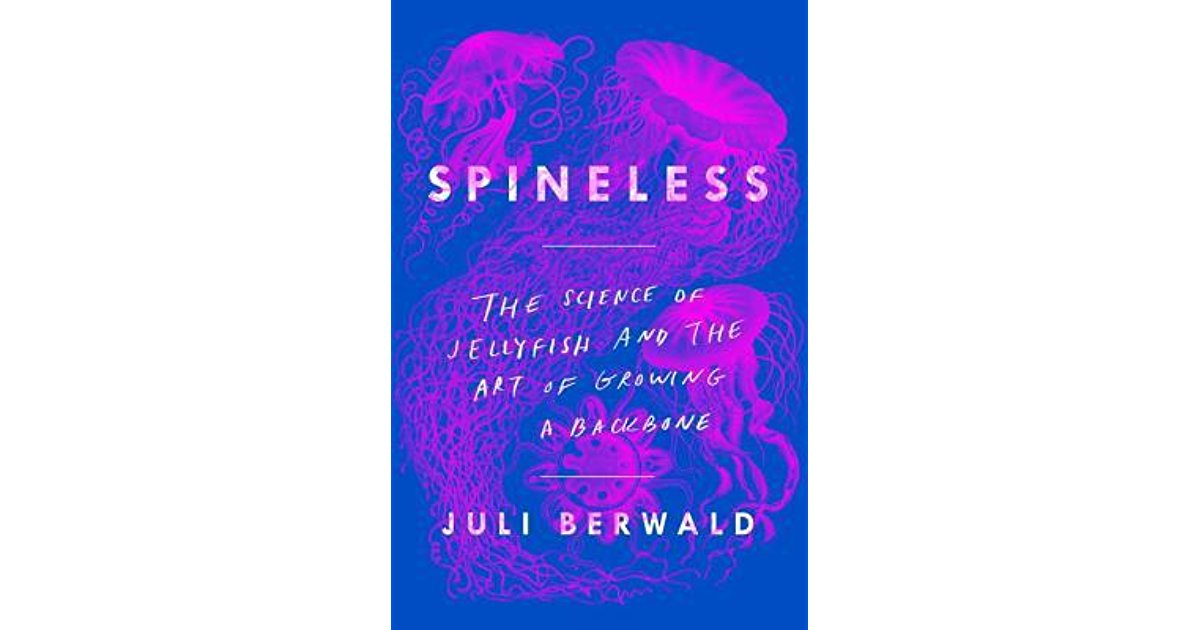
Spineless: the Science of Jellyfish and the Art of Growing a Backbone


Brimming with interesting anecdotes and intriguing facts, Spineless: the science of jellyfish and the art of growing a backbone is written in an engaging style that highlights the author’s academic background (she has a PhD in Ocean Science from USC) and her work as a textbook writer, especially when she connects obscure scientific concepts with tangible examples that most people can relate to.

Juli Berwald’s message to readers resonates in her journey from a hapless undergraduate to the discovery of her passion and fascination for jellyfish and the journey she embarks on to become an advocate for the preservation of underwater ecosystems. She details centuries of human discovery and scientific exploration of the world’s oceans while also highlighting the changes that have occurred as climate change, industrial fishing and sea transport have evolved.

In imparting this knowledge and raising awareness, Berwald also admits that there is no unique or singular solution to the changes being wrought under the oceans (and above it as well) but the urgency of her call to action is present throughout the book. She writes passionately about this subject, as can be seen from this passage:

We have reached a moment in history when we control the chemistry and biology of our planet. We are that powerful. But we are also endowed with gifts of even greater power. We have the capacity to communicate, to learn quickly, to change course, to create and re-create, to make decisions for the health of the oceans, to speak up. We can protect this stunning planet we all share if we grow a collective spine.

(Juli Berwald)

By focussing on jellyfish, Berwald provides a window through which the reader can see the need for awareness of the issues she discusses. As readers delve into the world of jellyfish and the complex ecosystems they inhabit, they will realize why jellyfish are being used by oceanologists as markers for tracking change in the oceans. One example that Berwald provides is in the jellyfish’s ability to thrive in acidic conditions. As ocean acidity increases year by year so do jellyfish populations, threatening the safe operations of nuclear power plants, of fish and plankton that are their natural and unnatural prey, as well as the safe use of beaches visited by people around the world. The impact can be devastating to many and that is the message the author wants readers to take away.

However, If that was the only message then this would be a dreadful read. It is not because Berwald has seamlessly included all sorts of interesting information about jellyfish as well. Partly from research and expert interviews, the information includes the jellyfish connection to the legend of medusa, the manner in which they reproduce and their potential powers of immortality.

Other pieces come from adventures that Berwald has embarked upon in her journey to becoming an advocate, such as trips jellyfishing along the West coast and her travels to Japan to swim with giant jellyfish. For those readers who feel up to it, there are some “try-it-at-home” adventures as well, such as having a jellyfish salad and keeping jellyfish as pets (Berwald’s attempt at the latter was unsuccessful, much to the noted dismay of her children).

There is a lot to discover in this book, and it is an easy engaging read. I would recommend this book to anyone who has an interest in learning more about the world underwater or an interest in gaining more knowledge about the effects of climate change.


Wednesday, April 11, 2018

The Last Resort: A Memoir of Mischief and Mayhem on a Family Farm in Africa


The Last Resort: A Memoir of Mischief and Mayhem on a Family Farm in Africa by Douglas Rogers was recommended to me. I have not read a book that was personally recommended to me in years. I usually have so many of my own books to read, or get them from the library, that I have ignored any titles that others may have recommended. The Last Resort tells the story of the author's parents and their resort in Zimbabwe at the time when the Mugabe government was expropriating farms owned and operated by white farmers. Rogers, born in Zimbabwe yet living in London, wrote a personal and detailed account of the government's encroachment upon his parents' property. Rosalind and Lyn Rogers, both born and raised in Zimbabwe, operated Drifters, the name for their home and backpacker lodge located in Mutare in eastern Zimbabwe near the Mozambique border. Douglas made frequent trips to Drifters and saw the ominous signs of governmental interference with each visit. Little by little the lodge was taken away from them, from the type of tenants who occupied the cabins to the sort of "business" operated within. Irony of ironies is that Drifters was not even classified by government inspectors as a farm, as it had no arable land. It was a money-making resort which was exempt from expropriation. Drifters was famous enough to have been written up in the Lonely Planet travel guides. 

In spite of government assurance that their property would not be expropriated because of its designation as non-farmland, Ros and Lyn were always prepared for a visit from the authorities and kept a rifle by their bedside. They did not live in fear, however. They went about their day-to-day business even while neighbouring farms were taken over or their farmers were attacked. They allowed the greenery around their resort to grow wild and untrimmed in order to hide it. The Rogerses never accepted whatever whimsical policies or characters the Mugabe regime sent their way. All too often they were met with a cloud of personless bureaucracy whenever they needed to talk to someone. Typical of Zimbabwean bureaucracy in the age of Mugabe was the endless runaround or goose-chase the farm owners had to contend with. The plight Ros had to endure to renew her passport will leave you with multiple eyerolls paired with bursts of exasperated laughter. Throughout this entire ordeal Douglas kept the laughs coming. You'd never think that a son, whose parents could face immediate eviction from a nighttime raid, would find anything funny in the matter. 

Douglas outlined the reasons behind Zimbabwe's hyperinflation when the government simply printed more money in its attempt to deal with the economic crisis. He made the story of the country's economic meltdown seem suspenseful and appealing. The national treasury printed banknotes in higher upon higher denominations, and the economy fell further into chaos. Ros Rogers wrote to her son:

"'I thought we had reached the bottom, but the elevator keeps going down,' Mom wrote to me. 'We are passing the basement now. Nevertheless, it is quite exciting to watch. You never know what a new day will bring.'"

Ros and Lyn had an incredible sense of resilience to feel this way. They never felt defeated as Drifters drifted into the hands of prostitutes, pimps, diamond miners and drug dealers. 

After I read this book I contacted the author via his website. The site featured dozens of colour photos of all the people in the book, including many of Ros and Lyn Rogers, as well as Drifters and the surrounding property. In my E-mail to Douglas I asked about his family and the state of Drifters. I am sad to say that in the preceding week, while I was still reading The Last Resort, Ros Rogers had died. Douglas had just visited his mother and father in Mutare. He told me that since the publication of The Last Resort, his parents had become quite famous and received many visitors, however Drifters has since closed. I love to reach out to authors when their books move me and the Rogerses' struggle against adversity will leave you feeling empowered among gales of laughter. I am truly saddened to hear of the death of Rosalind Rogers.