Monday, June 3, 2024

The Volunteers: How Halifax Women Won The Second World War

The Volunteers: How Halifax Women Won The Second World War by Lezlie Lowe told the stories of the countless women who came to the aid of the city and in turn their entire country during WWII. Through Lowe’s extensive research she was able to rescue these stories and give credit to many of these heroic women by naming them and giving them their deserved place in history. She pored over archived photos and local newspapers and proudly put names to those who helped make coffee and hundreds of sandwiches, knitted socks, gave inspirational talks to returning injured soldiers, organized charitable events, or otherwise gave their time to keep the war machine running. Since gender roles were so rigid in the 1940’s these volunteers had to do all of their wartime work in addition to their household and parenting duties. I don’t know how they found the time to do it all.

Thankfully Lowe was able to interview some of these women, who were by the time of publication in their late nineties or even centenarians. I am sure she thanked them and told them of the valuable role they played in their own fight for our freedom, yet when these women were acknowledged for their contributions, Lowe was often met with self-effacement. This book was published in 2022, 77 years after the end of WWII, and our Haligonian heroines were happy to tell the author that they were only trying to do their part and didn’t expect anything from it. It may have been nearly eight decades since the end of the war but their work was not forgotten and Lowe has ensured their names are part of the historical record.

Although this was a story that needed to be told, Lowe sullied the presentation of her research by using a teenage vernacular which, as an oral discourse, did not transfer to the printed page. I understand that she was trying to emphasize certain points by inserting interjectional phrasing to state the eyeroll-obvious, but there is no place in formal literature for passages such as these:

“Nova Scotia’s distaste for those who are not from here–‘come-from-away’ is the common quasi-pejorative–is difficult to explain to, um, those who aren’t from here.”

“Though a little late to the, um, party, in September 1942, Auxiliary Services Director E. A. Deacon requested that one small concert party be organized in each Canadian military district to supply outposts.”

“She had a habit of paying for things herself, and of calling in financial favours from central Canadians. She knew how to get shit done.”

“How many hours a week did I volunteer? No. Sweet. Clue.”

These are but a sample of teenage oral discourse which belittled the achievements of her heroines. Instead of focussing the reader’s attention on the volunteers, I could only shake my head and wonder what got into the mind of Lowe to write like that. Not to mention her numerous pregnant “Uh, yeah.” asides. Please, edit these lexicalizations out completely on the next printing. You can convey the same meaning and tone by using a more formal language that suits the text.

Lowe acknowledges the men and women who fought and gave their lives on the battlefield. Of course, one cannot write a book about the sacrifices volunteer Haligonian women made during the war without paying tribute to those who died for the cause. Those who paid the ultimate price were known to history, and documentation pays tribute to those who served. However the women who stayed at home may never have even found their names on an official volunteer roster, or if such a list existed, it has long been lost. Lowe brings up a valuable point made by Sharon MacDonald, author of Hidden Costs, Hidden Labours: Women in Nova Scotia During Two World Wars:

“So, how to count? ‘Perhaps the sheer enormity of the relief work,’ MacDonald writes, ‘can only be grasped by quantifying it and yet, endless lists of numbers of bandages and quilts and knitted socks have a difficult time competing with lists of battles and dead soldiers.'”

The Volunteers is a thank-you to the countless women who gave their time to help those in need during WWII. We can do our part by reading their stories and learning of their valuable contributions.

Find this book in the Mississauga Library System's on-line catalogue 

Wednesday, May 1, 2024

Looks Can Kill: A Doctor’s Journey through Steroids, Addiction and Online Fitness Culture


Looks Can Kill: A Doctor’s Journey through Steroids, Addiction and Online Fitness Culture by Riam Shammaa with Patricia Pearson addressed the dangerous steps men and women are willing to take in order to pursue their ideal fitness goals. Whether in pursuit of a heavily muscled physique for a bodybuilding show or a sinewy and taut body for a bikini competition, men and women are taking drastic measures to achieve the perfect look.

I was glad to read what the bodybuilding and fitness literature has always denied. Shammaa, a doctor with expertise in musculoskeletal and sports medicine, calls out all the competitors who enter these physique competitions as users and abusers of appearance-enhancing drugs (AED). We are not talking merely about performance-enhancing drugs like anabolic steroids, but the entire medicine chest of substances that physique competitors ingest or inject in order to strive for their impression of the perfect look, such as insulin, diuretics, human growth hormone and estrogen blockers.

Shammaa states it plainly: there is no way that anyone can achieve these kinds of physiques naturally. End of. Physique competitors in their quest for bodily perfection must take more and more drugs to offset the deleterious side effects of whatever pills or substances they’re taking. Without medical or pharmacological degrees, physique competitors are learning about these drugs on-line via “bro science” and are dosing themselves. Since they are likely obtaining their drugs illegally, they are taking even more chances with their health regarding what they are injecting or ingesting.

As one who follows the competitive bodybuilding scene I am aware of the winners of the major shows yet I am also aware of the overwhelming number of injuries and deaths that have occurred. If any other professional athletic association recorded so many deaths among its elite competitors, not only of retired champions but also among active members, there would be a tribunal to find out why. The elephant in the room is the pharmacological playground known as appearance-enhancing drugs. Yet nothing is done about it because without the AED, every physique association would be out of business and there would be no fitness industry.

One of the book’s contributors was not afraid to state the brutal truth: the only reason elite bodybuilders and physique competitors have managed to get on stage is solely on account of not having died yet. Those who win the top titles are the luckiest ones who have cheated death (so far). Imagine if anyone had said that about players in the World Series or the Super Bowl.

Shammaa addresses muscle dysmorphia, which refers to the distorted impression of oneself as less muscular than one actually is. He uses other street terms for this disorder, including megarexia, which I had never heard of before, yet did not include bigorexia, which is the most common term, at least in terms of Google hits. The rise of social media and photo sharing has led to the epidemic of perfect lives and perfect bodies, no doubt leading to the quest to be more muscular or leaner than others. Shammaa wrote:

“Bodybuilding and fitness competitions become a kind of breeding ground for muscle dysmorphia, because they hold you to–and indeed expect you to achieve–extremely unrealistic standards of what healthy musculature should look like.”

and:

“Instagram is a powerful platform for reinforcing shame, as are Pornhub and other visual media sites.”

I sped through this book, not only because I was interested in the subject matter but also because of the way it was written. Shammaa discussed some anatomical and metabolic processes in language that made it easy for the layperson to understand. In fact, one remark I made early in my notes is that Shammaa tended to oversimplify things. I wondered who he was writing this book for.

Eating disorder specialist psychiatrist Dr. Leora Pinhas summed it up the best:

“If our aim was health, none of us would look like that.”

Find this book in the Mississauga Library System's on-line catalogue 

Friday, January 19, 2024

Unmask Alice: LSD, Satanic Panic, and the Imposter Behind the World’s Most Notorious Diaries


I read Go Ask Alice forty years ago and as a diarist myself I enjoyed peeking into the private world of another teen. My own strong sense of living clean steered me clear of drugs so the diary did not influence me as a moralistic horror story to just say no. Only after I read Alice’s diary did I start doing my own research and discovered that the entire diary was a hoax. I have been interested in the real story behind Go Ask Alice for decades, and was immediately drawn to the new library acquisition Unmask Alice: LSD, Satanic Panic, and the Imposter Behind the World’s Most Notorious Diaries by Rick Emerson.

Emerson exposed the truth behind the alleged diary’s real author and while the secret had been out for decades, his exposé revealed more about the background of Beatrice Sparks and her motivation to swindle the public. Emerson painted Sparks as a wannabe author driven to achieve the heights of fame and if she fudged the truth to get there, so what? As long as her “anonymous” works were serving their purpose of educating people about the evils of drug use or Satan worship, then her ends would justify the means:

“Sparks was a walking correction. When she talked about the dead girl, dates and details shifted, almost at random. Alice died in May, but sometimes November. Alice gave Sparks the diary, except when her parents did it. Sparks occasionally mentioned ‘interview tapes’ she’d made with Alice, but nobody ever heard them.”

The publishers, who believed the story that Go Ask Alice was based on a genuine diary Sparks had acquired through her dubious claim as a youth counsellor, thought that the book would have more of an impact if it was marketed without her name on it. Teens would be more likely to buy the book if it presented itself as a work created without the intervention of adults, whether they were editors or mail-order PhD’s (as she was). So her books were bestsellers and are still in print and for the rest of her life Sparks remained ticked off that fame eluded her and no one knew who she was.

The Satanic Panic in the title refers to the second diary Sparks acquired, from a real teen named Alden Barrett who died by suicide. In this case Sparks did borrow Barrett’s actual journal, yet created a faux diary (which was published under the name Jay’s Journal) about his obsession with satanism. Barrett was not a satanist yet Sparks linked his suicide to the occult. Jay’s Journal was a complete fabrication created as a cautionary tale to warn teens and their parents about the evil found in Ouija boards, tarot cards, black magic and so on. Sparks would later write other diaries, all supposedly based upon the youth she counselled in her nonexistent practice, to warn teens of premarital sex and pregnancy, STD’s, and running away from home, among other topics. They all shared the common thread of being diaries she obtained from her clients. That sounds too convenient to be true and critics wondered just how she was able to get her hands on yet another diary–which reads exactly the same as all the others.

Emerson did his research, interviewing members of the Barrett family and uncovering documentation to refute the existence of Alice’s diary, but he did find who could very well be the real-life inspiration for Alice.

Unmask Alice was a rapid read, not only because I was enthralled with the subject matter, but on account of its layout: short chapters and multiple sections within each chapter. Thus there was always time to read a bit extra as I am loathe to start reading a new chapter if I know I will have to stop reading within a few minutes. Emerson explained why he avoided including endnotes within the body of text yet the few that he did include I found to be trivial and in some cases snarky, two reasons which should not warrant the need for them in the first place.


Monday, October 16, 2023

Peace by Chocolate: The Hadhad Family’s Remarkable Journey from Syria to Canada


Each trip to Nova Scotia means a stop at the Peace by Chocolate Boutique on Lower Water Street in Halifax. I buy more chocolate there to use as gifts than I buy for myself, and now that I think of it I cannot recall any time when I went there for purely selfish reasons. I chose Peace by Chocolate to supply the small gifts to those who attended my own wedding. In fact, on one shopping trip there, I had bought so much that I qualified to receive a free T-shirt (that may have been in March of last year). Thus I was well familiar with the company and the family that established it.

Peace by Chocolate: The Hadhad Family’s Remarkable Journey from Syria to Canada by Jon Tattrie tells their story as successful chocolatiers who fled war to build a new life in Canada. The man in the foreground on the book cover is Tareq Hadhad, son of Isam and Shahnaz who stand behind him. Isam founded the company and built it from a home business where he did everything from his own kitchen, eventually expanding to the basement, then to a separate shed and then on to industrial factory proportions. As Tareq’s education in pursuit of becoming a doctor proved impossible as Syria plunged deeper into war, he had to think of survival as a priority and how to get himself and his large family out of the country.

As the war raged, the chocolate business was bombed and family members were killed or simply disappeared. The Hadhads managed to escape to Lebanon and sought refuge via UN organizations. Meanwhile, in communities all across Canada, grassroots efforts by concerned citizens looked into ways to sponsor Syrian families. One such group in Antigonish worked heroically to raise funds, find housing, clothing and supplies for a new family. Tareq arrived in Canada first, and decided to settle in Antigonish instead of moving to a bigger city. His extended family came a few months later.

Tattrie presented a story, noble as it was, but wrought with Übermensch heroics of the Nova Scotians who worked tirelessly and selflessly to bring the Hadhads to Canada. I might be jaded or a tad sceptical in thinking that humanitarian actions even among Canadians don’t extend that far in terms of degree of generosity offered. How the refugee committee members found the time to lead their day-to-day lives and nine-to-five workdays amidst the colossal work and planning that needed to be undertaken seemed to be of Hallmark Channel movie proportions. That there were times when I was nearly moved to tears by their efforts shows how effective Tattrie was in grabbing the reader’s emotions. That all said, I feel that this book outruns any Debbie Macomber Christmas novel for schmaltz factor.

Ultimately Peace by Chocolate is a love story from the Hadhad family to Canada. Their mission is one of gratitude to Canada and a devotion to promoting peace. I genuinely feel the family’s sincerity every time I walk into their store, as their chocolate bar wrappers show their love of inclusion and embracement of diversity. As an example of this inclusion, Tattrie wrote about one of the store’s early Mother’s Day chocolate packages, which included bars for lesbian mothers, mothers-to-be, and for those mothers who have lost a child. Tareq’s mission statement is:

“Peace is for everyone on Earth. My family is always going to fight for peace with every piece of chocolate.”

This reminded me of my own invented term, chocolate diplomacy, when I visited the Democratic People’s Republic of Korea. If the Hadhads have found success in promoting peace by chocolate, they have the power to spread it internationally.

Find this book in the Mississauga Library System's on-line catalogue

Tuesday, September 12, 2023

Yoko Ono: An Artful Life


Yoko Ono: An Artful Life by Donald Brackett was a short biography (249 pages) and, although I was familiar with the life of Yoko Ono, this was a slower read than I expected. Dewey classified the book as an artist biography (at 700.92) yet our library system preferred 782.42166 (rock musicians biography). I would say that Dewey got it right (and even the Toronto Public Library thinks so) and will let my library’s cataloguing department know about my assessment. That said, the author is from the art world and is a curator, art dealer and critic, so he came to the subject matter with exemplary credentials. I found his writing about Yoko’s early years as an artist to be slow reading, but such is the state of academic literature.

Early into the book he analyzes Cut Piece, Yoko’s most famous piece of performance art. In this piece, she sits silently on stage after inviting members of the audience to come up and cut off pieces of her clothing. She has performed this piece numerous times on three continents, most recently in 2003 at the age of seventy. Here is a woman who had no issue whatsoever with public nudity, as only three years after the clip below, she was posing nude with John Lennon on the cover of Two Virgins. Brackett’s examination of Cut Piece was poignant and spot-on:

“Now considered a classic of feminist art, Cut Piece was possibly Yoko’s most daring public performance piece ever. Her chief raw material for the act was ‘some anger and turbulence in my heart,’ she later told Record Collector magazine. The intensity of feeling generated by the piece would stay with her: ‘That was a frightening experience, and a bit embarrassing. It was something that I insisted on–in the Zen tradition of doing the thing which is the most embarrassing for you to do, and seeing what you come up with and how you deal with it.'”

Brackett provided a history of Ono’s early performance pieces, happenings, gallery shows and written works. Readers who were led to believe that Ono only started to get into art and music after she met John Lennon would be shocked to learn how far back her art history goes. Lennon was still a teenager when she was starting to make a name for herself.

However when he examined Ono’s musical oeuvre his writing was less inspired and, his alleged facts, at times, were unfortunately incorrect. He often got dates wrong (the photos insert was rife with anachronisms) and he assigned songs to the wrong albums, however two specific errors ruined the overall academic tone of the book, such as referring to Gibraltar as an island, and the misspelling Ghandi (embarrassingly, twice).

If Brackett was more qualified to critique Ono as an artist, at least he sought others to evaluate her as a musician, and even then sometimes erred when he himself was praising her. For example, in his critique of what I consider to be Ono’s single best song ever, “Why” (from her debut album Yoko Ono/Plastic Ono Band), Brackett is mistaken in claiming that John Lennon is playing, of all things, a slide guitar:

“The first song on the album, ‘Why,’ is an extended vocal exercise in which Yoko screams, cackles, howls, and laughs the title word over and over, with John playing a haunting slide guitar in the background. ‘Even we didn’t know where Yoko’s voice started and where my guitar ended on the intro,’ he shared. ‘It became like a dialogue rather than a monologue and I like that, stimulating each other.'”

Brackett quotes a musician who does know a lot more about guitar playing in his own review of “Why”:

“Captain Beefheart guitarist Gary Lucas was most impressed with Lennon’s musicianship on the album: “[He] was always able to make his guitar talk. He was one of the most visceral from-the-gut rock guitarists of all time. But never more so than on ‘Why,’ where his guitar spits lovely, processed shards of metal to inspire Yoko Ono’s uninhibited caterwauling. This is some of the most radical guitar soloing of the era, rivaling Lou Reed’s ‘I Heard Her Call My Name,’ Syd Barrett’s ‘Interstellar Overdrive,’ and Robert Fripp on ‘Cat Food’ for sheer conic bravado.’ But Yoko’s voice is without a doubt the star of her album.”

Cashbox magazine reported:

“Yoko Ono sums up the philosophy of the age as succinctly as anybody yet has in her first two sides here, ‘Why’ and ‘Why Not.’ Mrs. Lennon’s voice is the most interesting new instrument since the Moog Synthesizer and she uses it throughout.”

Duncan Fallowell reported in the Spectator:

“The first track is the most ferocious and frantic piece of rock I’ve heard in a long time and sets the pace for much of the rest. The most extraordinary feature of all is Yoko’s high-pitched voice which she uses not for singing but for producing stream of vocal effects. This produces a whole new territory of sound which, in pop, she is alone in exploring with any thoroughness, and unless her voice has been fed through electronic modulators she has quite remarkable tonsils. But I doubt this album will receive the attention it deserves, such is the antipathy toward Yoko Ono that she can do no right. Yet why she should be the object of such derision and plain insult I have never been able to understand. A couple of odd films and odd records hardly explains it.”

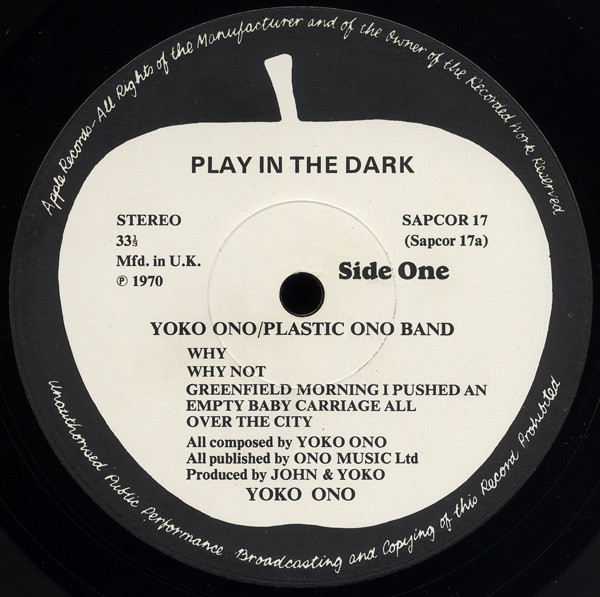
In 1970, when this album was released, these few critics responded to it favourably. Most of them treated it as a curiosity and shrugged if off as another example of Ono’s banzai banalities. But even now, 53 years later, it is still way ahead of its time, and has grown in public appreciation by both critics and the public. I find that I can never listen to the one single song, “Why”. I am drawn to listen to the entire album. Follow the instructions on the label of the original UK LP: PLAY IN THE DARK:

Ono has remarked facetiously that she already knows what the newspapers will write about her as an epitaph. She has lived through more negativity in the press than any other artist or entertainer, and sadly the hate levelled against her was often tainted with racism and misogyny. However I believe that the public opinion of her has changed since she made that prescient statement about her own demise. I like the way Brackett ended the book:

“She has been both a brave individualist who lived her life as art, and a sometimes savvy, sometimes naive creator of a Warholian public image that has taken on a life of its own. If recent years are any indication, she will be appreciated in both dimensions as an enigmatic, gifted, generous, quirky, surprising, thought-provoking, paradoxical, and thoroughly mesmerizing presence, and a mirror not only of her own times but of times to come.”

Find this book in the Mississauga Library System's on-line catalogue

Wednesday, August 16, 2023

Too Many Men on the Ice: The 1978-1979 Boston Bruins and the Most Famous Penalty in Hockey History


Too Many Men on the Ice: The 1978-1979 Boston Bruins and the Most Famous Penalty in Hockey History by John G. Robertson is the second sports book I have read in the past month written by a member of the Scrabble community (following Wild and Outside). When I first saw Too Many Men on the Ice, a large-format paperback at 202 pages, I wondered how Robertson could write about a penalty for that long. While he certainly wrote about the penalty that likely cost the Boston Bruins the Stanley Cup in 1979, he also provided an extensive backstory, outlining the Bruins’ rivalry with the Montreal Canadiens and how the American team almost always tanked against them in the playoffs. I like how Robertson prefaced this fateful game:

“It also encapsulated the immense frustration that the Bruins’ players, coaches, management and fans have felt for decades over their team’s infuriating inability to upend the Habs in the playoffs and win critical games at the Montreal Forum.”

With the semifinals tied at three games apiece, Boston faced Montreal for game seven at the Forum. A late penalty in the third period against Boston for having too many men on the ice gave Montreal the opportunity to tie the game, and indeed Guy Lafleur scored on the power play with 1:14 left in regulation time. The Habs scored in sudden death and proceeded to the finals against the much weaker New York Rangers. The Canadiens defeated the Rangers 4-1 and were Stanley Cup champions once again.

I had never known about this infamous game or penalty, and Robertson made the game, as well as all the games he covered with play-by-play commentary, read as exciting as they could be without being there in person. The Bruins’ coach, Don Cherry, was the most colourful of hockey personalities for his wardrobe as well as his banter and he provided insightful game analysis and always a quotable line. It was never a boring read whenever Cherry was on the scene. I will admit that the double-page spreads of solid text looked daunting, especially since I am not usually a reader of sports books, but with this one I couldn’t put it down. The writing flowed so fast, just like the action in a hockey game. It was a pleasure to read.

Robertson researched this book like mad and the chapter notes were bursting. I used his endnotes to find Toronto Star articles on-line.

 Find this book in the Mississauga Library System's on-line catalogue 

Wednesday, August 9, 2023

Brown Boy: a memoir


I know Omer Aziz from the Mississauga Central Library and also from the nextdoor YMCA. I admired his passion for books as I always saw him reading in the library as well as in the gym. He was genuinely interested in what I was reading too. I am always enthusiastic to talk about books and while my tastes, as seen in my blog reviews, are all over the subject map, Omer kept more to the classics. I could see that he was reading from the panoply of world literature. He even took books into the Y’s sauna and I worried that dripping sweat would damage them. How could you read comfortably when the pages were turning into wet tissue paper? We also chatted about publishing and the sorry state of self-published works; thus I am glad that his memoir was published by Simon & Schuster [1].

Omer wrote about his life as a Canadian of Pakistani origin, growing up in Scarborough and then in Mississauga. His father is a secular Muslim (whom I still see every day at the Y) while his mother is strictly religious, so he was pulled in different directions all his life. After the world changed on 11 September 2001 Omer’s world changed too, as I am sure it did for all Muslims and for anyone whose skin colour was brown.

After years of unimpressive grades Omer had an epiphany during the 2008 presidential campaign. The leading Democrat candidate was Barack Obama, and seeing a man of colour speak so eloquently gave Omer inspiration to refocus his life on his education. He started an impressive campaign of his own to read the classics. He would eventually became a star student and won scholarships to Queen’s University, University of Cambridge and then to Yale Law School. I liked this memory he shared about how he found room for all his books:

“My father and I soon got to work building a study in the house. Since leaving for college, I had accumulated hundreds of books and had nowhere to put them. Together, we tore down a room, painted the walls light brown, and built a bookshelf. It was like I was back in those childhood days watching my father work under the hood of the car, me handing him tools. When the room was done, I finally had a place to study with my books surrounding me, each one a special purchase I had made from a used bookstore.”

This is the Omer I know: the voracious reader. His scholarships got him into good universities where he excelled (as in the above three locations) or failed (he wasted his time at the Paris Institute of Political Studies). In spite of the prejudices around him, where brown boys were considered threats and not academics, Omer worked tirelessly to prove himself as deserved of a higher education. The passages below show what he was up against. They also show that in spite of what others may have done to keep him down, he was also fearless in his pursuit of academia:

“What kind of dream had I been pursuing all these years, trying to educate myself out of my own skin, reading every book I could get my hands on, separating myself from my past, that in a single instant this stranger could put me right back into the box from which I sprang?”

and:

“Dada had never been close to anyone, but I realized how my father and I were not that different. He was the brash immigrant who was fearless in sharing his opinions, even if he valued safety above all else. I was the son of immigrants born on this soil who was willing to look beyond the safety nets and take risks in pursuit of my dreams. We were mirrors of each other in certain ways, both of us with big imaginations that could be not curtailed by those around us.” [2]

Brown Boy was written in a conversational style with reimagined dialogue. It was a seamless read where his jumping from continent to continent, as well as from university to university, never seemed to be impulsive. He shared his reasons for choosing each institution, weighing the pros and cons over other locations and we eagerly awaited the mail delivery containing each acceptance letter. It would have been far easier to create a memoir that stuck to a timeline: first I went here, then there, then dropped out in Paris then did this… and it would have ended up a boring read. With Brown Boy I was always looking forward to Omar’s next academic adventure and professional success. He is an inspiration to us all.

[1] Reputable publisher that it is, yet the proofreaders still let Adolph Hitler get by (instead of Adolf) and left adjacent alternate spellings of Grandad and Great-Granddad. Omer alternated spellings of imposter (p. 147 and p. 253) with impostor (p. 251).

[2] The final line in the passage above was quoted verbatim, thus could be not curtailed when I believe it should have been could not be curtailed.

 Find this book in the Mississauga Library System's on-line catalogue