Friday, June 26, 2015

The Innovators: How a Group of Hackers, Geniuses, and Geeks Created the Digital Revolution

by Walter Isaacson


Cover image for The innovators : how a group of hackers, geniuses, and geeks created the digital revolution

Isaacson, author or the best-seller, Steve Jobs, continues to explore the computer industry in his latest book, The Innovators. This time he traces its history – and tells the colourful saga of those first inventors and they who followed.

Did you know that Lady Ada Lovelace, daughter of Lord Byron, applied her imagination to mathematics as her father did to poetry, and envisioned a “general-purpose machine” about 100 years or more before it was technologically possible to create one? Yes, in fact, Isaacson repeatedly refers to her creative spirit as a source of inspiration to many of her successors.

From the creation of the first digital machines, to the advent of computer programming, the invention of the microchip, the video game, the personal computer, the Internet, and the myriad of computer software applications, Isaacson captivates the reader by revealing the colourful personalities – men and women – at the heart of “the computer revolution”. The chapters on Lady Lovelace and her business partner, Charles Babbage; the Harvard undergrad/drop-out Bill Gates; Alan Turing; and the development of the Internet, may especially engage readers.

Isaacson’s chronological progression, fascinating insights into the innovators’ personalities, and his own personable narrative style, make this “a good read” – and a long one, at 488 pages excluding the endnotes, photo credits, and index. 

Perhaps this is a book to enjoy while on summer vacation?

Find this book in the Mississauga Library System on-line catalogue.

Monday, June 15, 2015

Fallingwater Rising: Frank Lloyd Wright, E. J. Kaufmann, and America's Most Extraordinary House


In the prologue to Fallingwater Rising: Frank Lloyd Wright, E. J. Kaufmann, and America's Most Extraordinary House, author Franklin Toker writes, "Put this book down now if you can't live without the old myths about Fallingwater. But take comfort in the fact that a Fallingwater history shorn of miracles can still be thrilling."

Toker examines those old myths, and one by one, he uses his extensive and impeccable research to dismantle them. The truth, for me, was far more interesting.

I visited Fallingwater in 1999, and although I have a great interest in architecture and am captivated by that house, I thought a biography of a single building might be too detailed for my level of interest. I was wrong. The book does contain quite a lot of detail. But through that detail, and through his nearly palpable passion for his material, the author reveals the magnificence of Fallingwater and explicates the full depth of its meaning.

Toker weaves a social and cultural history of Fallingwater, placing it in context of Wright's career, Kaufmann's aspirations, the Depression, and the conflicting forces of architecture that were raging at the time. He shows how Fallingwater was sold to the American public, and how that hype permanently changed the country's perception of art and architecture. He analyzes what Fallingwater means in the context of art history and American identity. As Janet Maslin wrote in her review for The New York Times, "Nothing about the way Fallingwater was built, conceived, influenced or manipulated escapes the author's attention."

Some of Toker's claims border on the speculative, but he meticulously presents his evidence and makes his case, leaving the reader to decide if he's made too great a leap. Given that he spent nearly 20 years researching this book, the evidence is always substantial.

I was fascinated to learn that on the eve of Fallingwater's conception, the architecture community considered Wright washed up, a has-been. He had not completed a building in 13 years, and his work was thought to have become repetitive and - the worst insult possible - regressive. At almost 70 years old, Wright was living in relative isolation, both his personal life and his professional life mired in depression. Yet his two most famous, recognizable buildings - Fallingwater and the Guggenheim Museum - were still ahead of him. By the time he died in 1959 at age 91, Wright would be, without exaggeration, the most famous architect in the world, leaving behind an unrivaled body of work. How Wright transformed his career, his image, and the face of architecture through this one building is an amazing tale, and Toker tells it with sparkling writing and wit.

Incidentally, this book is a great eye-opener for those who reject certain art based on the politics or personal life of the artist. Wright, it appears, was staunchly anti-Semitic, although his two most famous buildings were created for Jewish clients. He admired the Nazis and the Third Reich, and disliked that "the Jews" were leading the U.S. into war. (Anti-Semitism and fascist tendencies are one of the threads running through this book, and very relevant to Fallingwater's context.) Wright was also a raging egotist who abandoned his wife and six children to have an affair with a client's wife. Wright the man was not exactly an admirable character. Wright the architect was a visionary and a genius.

Another note: I highly recommend keeping some internet-enabled device on hand while you read Fallingwater Rising. Toker references dozens of buildings, and few readers will be able to conjure mental images of each one. I kept my tablet handy, and did an image search for every building mentioned. This provided me with a context I wouldn't have found in the book alone, plus I ended up with a new short-list of buildings I'd like to see on my travels. [This review was originally published on wmtc.]

Wednesday, June 10, 2015

Krakatoa: The Day the World Exploded: August 27, 1883


I thoroughly enjoy the work of Simon Winchester. For two of his other books, The Professor and the Madman: A Tale of Murder, Insanity, and the Making of the Oxford English Dictionary and Outposts: Journeys to the Surviving Relics of the British Empire I gave the top five-star rating at Amazon and I extend the same top rating to Krakatoa: The Day the World Exploded: August 27, 1883. This is typical Winchester: nonfiction that I cannot put down, full of interesting trivial footnotes and long sentences loaded with parenthetical asides and clauses separated by commas which did not require rereading in order to fully understand. I tend to reread such lengthy sentences if I have to pause and take in a non sequitur parenthetical aside, yet Winchester makes everything flow in a rapid stream. It is a quite readable oral style that makes me laugh, even if the subject matter is the volcano Krakatoa, which was responsible for the deaths of over 36.000 people. 

The explosion of Krakatoa in 1883 has been called the worst volcanic eruption in modern history. Superlatives abound: it was the deadliest, loudest and expelled the most voluminous and wide-spreading spray of debris ever known. Winchester did not make the story prior to the eruption read like a boring airplane disaster movie, where you don't care about anything except the plane crash (or earthquake, or shipwreck) that was about to happen. Before he described the eruption and its aftereffects, Winchester needed to paint a backstory about the region. He presented both lengthy, yet at all times engrossing and wholly fascinating histories of Dutch colonialism in Indonesia, the dawn of international telegraphic communications as well as the progressive evolution of the science of plate tectonics. I am sure other authors would have driven me to sleep with such a patient breakdown of that particularly new scientific discovery. Plate tectonics and all the crusty goings-on beneath the ocean floor were crafted into a page-turning read. Diagrams, photos and paintings enhanced the text. Winchester explained the science behind the eruption, and how the (former) volcanic island got that way.

What would you do if smoke started seeping through your floor? Prior to the eruption, the population on nearby islands reported the ground under their homes starting to smoke. I can recall reading about the volcanic eruption on Tristan da Cunha in 1961, when islanders reported seeing the ground crack and split open. The Tristanians did not have dirt floors, but these Indonesians did, and the tremors and smoking ground foretold the devastation to come. Here is one observation from a nineteenth century "met station":

"He walked across to the observatory, noticing immediately that the needles and pens suspended by their cocoon-threads on his magnetic declinometer were ticking and trembling violently--not in the usual side-to-side sweeps that one might expect from an earthquake, but in a series of buzzing up-and-down motions that did not register properly on the paper rolling from the drum. The more he thought about it, the more he realized something odd: The vibrations were not so much being felt through his feet, as if they had emanated from somewhere deep in the earth; they were in fact being felt in the air. True, there were ground tremors, and buildings were shaking--this was self-evident. But most of the shaking was coming through the very atmosphere itself. And vibration of this kind was the very particular hallmark of an erupting volcano, not of the subterranean shaking of an earthquake." 

One aftereffect of a volcanic eruption on an island is a tsunami. In fact, several tsunamis. Abnormal wave movements were seen as far away as France; imagine the height and force of the waves at the epicentre. What I found haunting were Winchester's descriptions of pumice with lava-encrusted human skeletons washing up onto the shores of east Africa. While colossal in its destruction not only of structures, animals and human life, the eruption also cost Krakatoa its own life: the explosion was so strong that it blew the island off the map.

The volcanic ash painted the sky and gave the world the most extraordinary sunsets. Winchester wrote about the universal rush for canvas and paints as backyard art studios sprung up, with their artists recording the posteruptive skies in colour, which photography at that time could not yet capture. I now am more than interested in finding these paintings to get a glimpse of what the night sky looked like. 

In Krakatoa and the two other titles I have read so far, Winchester writes with an enthusiasm that tells the reader he had a great pleasure in researching and writing. I am most keen on reading other books in the Winchester oeuvre.


Monday, May 25, 2015

The First Family Detail: Secret Service Agents Reveal the Hidden Lives of the Presidents


I expected more from The First Family Detail: Secret Service Agents Reveal the Hidden Lives of the Presidents by Ronald Kessler. An exposé such as this should have been high on facts and low on tabloid innuendo. I came out learning absolutely nothing that I didn't already know via the standard press or even through the tabloid media. After checking the price of this book--$31 Canadian--I would have definitely felt ripped off. I had my prejudices about this book, I admit, before I read a single page. There is a suspicion that lurks within a book by its presentation alone. I am talking about the red flag that is the curse of a large typeface, wide margins and gaping spaces between the lines. This is a book not for scholars nor was it written by one; it was presented as a quick read for those who barely have an attention span left to manage through ten-page chapters. A book with this subject matter wouldn't be fleshed out to a mere 246 pages; it would be of legendary Henry Kissinger or Condoleezza Rice proportions.

Needless to say, I felt spoken down to as I read The First Family Detail. Symptomatic of the growing phenomenon (for some) of decreasing attention spans, Kessler felt the need to repeat the same tabloid gossip throughout the book, stating the same points over again even in chapters that were devoted to other people. The effect such repetition had was to make the points seem like a personal attack on the political figure and not as an observance of a distant yet objective reporter. Kessler's constant digs against Hillary Clinton:

"When in public, Hillary smiles and acts graciously. As soon as the cameras are gone, her angry personality, nastiness, and imperiousness become evident."

end up having the reverse effect. There are only so many times one can compare Clinton to Cruella de Vil before the reader is going to say enough already and discount everything the writer was attempting to convey about her. Kessler's tarnishing of Clinton backfired.

With such a secretive subject matter, it was impossible to get currently employed Secret Service agents to commit to their confessions with their names. Gossipy revelations about philandering presidents of the past won't endear an agent to his or her employer. So Kessler was left with no other alternative than to credit his inside information to "an agent", "another agent" or "a former agent". With no names, the anonymous tipsters made The First Family Detail read like a supermarket tabloid. I can understand the need to protect the agents' identities, but that didn't help the way the book read. Yet again a revelation, and yet again, it was provided by "an agent". Even the confessions of Deep Throat were presented more professionally and were written for an intelligent reader.

I shouldn't have expected The First Family Detail to be a serious or even a significant read. If you had been stranded on a wireless island since Kennedy's assassination then this book would have filled in all the gaps about presidential security lapses. Of all the topics to deal with in a book like this, the big one--Kennedy's assassination--Kessler devoted only a part of the ten-page chapter entitled "Dallas" to it. Just a part--the chapter was in fact devoted to the four presidential assassinations in chronological order. And what new revelations can one possibly learn in the four pages about the Kennedy assassination? Absolutely nothing that we didn't already know.

Kessler makes a repeated case for the serious state of underfunding that the Secret Service receives. Agents confess to the author how difficult it is to provide the utmost level of security to the most powerful people on the planet when their resources are continually being cut:

"'We don't have enough people or the equipment to do protection the way they advertise they do,' a veteran agent says. 'And how we have not had an incident up to this point is truly amazing--a miracle.'"

Kessler's sources allege that the Secret Service is mismanaged by guys at the top who show no support for their agents. There is no extension of solidarity up the line. This is felt most often in cases where the person who is protected (the protectee) might request, or even demand, the agents to be less visible or even for the agents to disappear. Policy states that if the protectee makes these demands, the Secret Service will honour them. Yet agents who abandon the surveillance of a protectee are treated as insubordinates open to retribution. It is a lose-lose situation for these agents.

The First Family Detail provided a promising subject yet ultimately was a disappointment. What a tease for the publisher to put Jacqueline Kennedy on the cover yet Kessler barely even mentioned her. I was hoping to read about Mrs. Kennedy's Secret Service coverage after the death of JFK, and how her own Secret Service protection had to end when she married Aristotle Onassis. The First Family Detail--not detailed enough.

Wednesday, May 20, 2015

All Things Shining: Reading the Western Classics to Find Meaning in a Secular Age


A return to ancient Greek polytheism. That’s the answer.  What is the question? The question, or better the dilemma, is the modern and very desperate struggle to escape nihilism. In its starkest terms, nihilism is the belief that the universe (life) is ultimately meaninglessness. In the dim light of nihilism paralysing fatalism and suicide are genuine life-options.

Hubert Dreyfus and Sean Dorrance Kelly tackle the challenge of nihilism head on in their book All Things Shining. Their answer is not exactly a return to polytheism but rather harvesting something of its spirit. There was a sense in ancient Greece that autonomous persons were not all that autonomous, that a man or woman’s existence was not fully and completely their own responsibility. The gods played their parts and individuals could be swept up in events greater than themselves. This was understood and accepted.

In a secular world that is embracing relativism faster than the spread of cellphones the all important search for meaning and values has become the great challenge of our times. One strategy for dealing with this challenge could be to examine our history and figure out how our ancestors viewed their own humanity in relation to sources of meaning outside of themselves. The examination of western literary classics, then, could be just the ticket for discovering and then borrowing insights from people who believed in objective sources of values. The authors take this idea and explore it using classics such as the plays by Aeschylus, Dante’s Divine Comedy and Melville’s Moby Dick among others. Some insights lead to dead ends. Interestingly, and controversially, the authors argue that Dante’s beatific vision in the finale of the Paradiso and with it the whole of western style monotheism is just another road to nihilism. Some of the other classics, however, offer promising intuitions. Melville’s great work belongs to this category with its portrayal of Ahab and his monomaniacal pursuit of ultimate truth in hunting the white whale (i.e. the representation of ultimate truth and mystery).

The mining for evidence and lessons regarding this spirit of possession (my phrase) through the classics yields some thought-provoking findings. Art is a gargantuan topic for any single, slim volume to cover and the authors, quite legitimately, provide only a brief taste of the plethora of western literature. But one of the more interesting strands they pick up is the old idea that works of art work.  Art has the capacity to infuse and inform a culture. Allow me a simple example to elucidate. Have a look at an ancient Greek temple. Today it is a decayed, crumbling semi-organized pile of stones. In its heyday it was a shining, painted symbol of Greek civilization. The temple was alive. It manifested a way of life. Men and women knew who they were and their place in the cosmos thanks in part to this structure so full of meaning. How times have changed for the temples of the Greek pantheon. They are little more than the play things of classicists and archaeologists, better understood today as tourist attractions good for a photo but completely lacking in the power (spiritual power?) to enliven a culture and focus the hopes and dreams and efforts of a people.  Banks and cellphone towers and condominiums don’t give us the thing we crave. Something has clearly been lost. But what is this something? Placing the marble and stones of the old temples under a magnifying glass would never reveal the secret.  And this is what the authors are pointing at. There is something missing from our technologically advanced, scientific world. It is a spiritual thing. We need to get it back. How? The answer is polytheism—kind of.

The polytheism that is ultimately endorsed by the authors can be categorized fairly if simplistically as “going with the flow.” To my understanding, their claim for a meaningful life is reminiscent of the Stoic advocacy of living in accordance with nature (nature very broadly construed and incorporating aspects of laws and fate). There are limitations to this attempt at a correlation. The authors would object to it because the Stoics had a very deterministic view of the world. We (the hip west) are way too autonomous for stoicism. The authors would insist that it is ultimately up to each individual whether or not to heed the call of the gods.

And there you have it. It is our autonomy, our unquenchable sense of self that has banished the gods. The gods aren't dead, you see, there just isn't room for them in this world of inflated egos. You and I have drained the world of its haunted character. In the end the authors’ message is a hopeful one. The new polytheism that they promote provides strings of meaning revealed through our science, technology and art. If we open ourselves to the call of meaning we too can be possessed the way Helen of Troy was by the events roaring around her.  

Tuesday, May 19, 2015

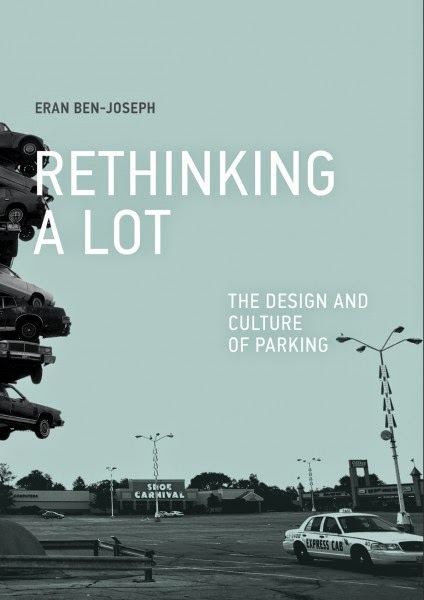
ReThinking a Lot: The Design and Culture of Parking


ReThinking a Lot: The Design and Culture of Parking by Eran Ben-Joseph is a beautiful book from the MIT Press. Fully illustrated and printed on very heavy paper, although it only had 157 pages the book seemed a lot thicker. It was a pleasure to hold and examine ReThinking a Lot, and I learned more than I could ever imagine about parking lot construction, the history of parking lots and about the environmental impact lots have wrought. A casual reader such as myself can be entertained by a book about parking lots, and Ben-Joseph showed how lots can serve drivers as well as those without cars.

Through data gathered from municipal plans, parking revenues and mall layouts, Ben-Joseph asserts that there is a superabundance of parking places in the US. So how come drivers are always complaining about the lack of parking? The answer is that drivers are greedy, and expect a convenient spot everywhere they go. This sense of entitlement makes drivers circle endlessly through lots looking for a better spot. Ben-Joseph cites a study about this circling phenomenon, which concludes that drivers who park further away from their destination (like the mall doors) take less time getting there than drivers who keep trying to find a spot that is closer. In the long run, the extra driving doesn't pay off.

Ben-Joseph continues:

"Something similar to this 'split personality' is at play in our attitudes toward parking lots; we demand convenient parking everywhere we go, and then learn not to see the vast, unsightly spaces that result. For many, parking lots are a necessary evil--we hate them, but we can't do without them."

It is this reference to lots as "unsightly spaces" that interests the author the most:

"Parking lots may be utilitarian and practical, unexceptional, and even unpleasant, but their magnitude and sheer frequency of occurrence merit greater attention. The task is first to rediscover their virtues and common good, and second to elevate their design beyond mediocrity. Even when dealing with the generic, there should be ambition and a desire for perfection."

Nothing is more unsightly than a blacktop lot radiating heat. What can be done to make lots more attractive? Ben-Joseph examines many lots that integrate the natural environment and which are friendly towards their surroundings as well. Asphalt is impervious and hinders drainage. It also creates parking lots of soaring heat. Wastewater and rain can be absorbed by using grass or porous paving materials. Sports stadiums, homes to many of the biggest lots which lie empty most of the time, are the biggest offenders. Why not use these porous materials or otherwise landscape the surface to better drain water? Plenty of examples were given--most of them in Europe--where the lots are camouflaged by tree cover and are thus shaded, making it less of an oppressive atmosphere to walk from or back to one's car.

Landscaping in parking lots has benefits other than to the environment. Ben-Joseph states:

"CPTED [crime prevention through environmental design] strategies toward crime prevention and the increased perception of safety have also been applied to parking lot design. While one of the most common parking lot design approaches is to maintain vistas and reduce vegetation (natural surveillance), research also shows that feeling secure in parking lots correlates with attractive landscaping. The research suggests that vegetation may increase perceptions of both attractiveness and security if it is well maintained and attractively landscaped. The presence of unmaintained, weedy vegetation might have the opposite effect on security perceptions, particularly in isolated, rundown areas."

When parking lots are not occupied by cars, they lie open and ready for the taking. Ben-Joseph discussed alternative uses for parking lots, many of which originated as spontaneous drop-in events like flea markets and concerts. A wide open space free for the taking is irresistible for those who are hosting community events which draw mainly pedestrians--hence no need for parking.

"As the examples in this book illustrate, a successful parking lot is one that integrates its site conditions and context, takes measures to mitigate its impacts on the environment, and gives consideration to aesthetics as well as the driver-parker experience. Designed with conscientious intent, parking lots could actually become significant public spaces, contributing as much to their communities as great boulevards, parks, or plazas. For this to happen, we need to release ourselves from the singular, auto-centric outlook for the use of the lot. We need to reevaluate conventional parking requirements against evolving lifestyles and changing priorities. Above all, we need to accept that parking lots are primary settings for many aspects of public life for Americans, and for a growing number of others across the globe. For something that occupies such a vast amount of land, and is used on a daily basis, the parking lot has received scant attention. It's time to ask: what can a parking lot be? It's time to rethink the lot."

The MIT Press made ReThinking a Lot attractive to the look and touch. Its typeface was unfortunately too small for me, and I read the book at home with a magnifying glass. I found steadying a magnifying glass while trying to read on the bus not easy. The lengthy captions under the photos were repeated word for word in the adjacent text, so there was a lot of redundancy when a shorter caption would have sufficed.

Thursday, May 7, 2015

Without You, There Is No Us: My Time with the Sons of North Korea's Elite: A Memoir


Suki Kim taught English to the sons of North Korea's elite at the Pyongyang University of Science and Technology in 2011. Her perception of life in Pyongyang was the most accurate account I have ever read. I can make this remark because I myself have been there, and as it so happens we were there at the same time. Other writers, journalists even, have padded their own DPRK tales with sensationalism, and Kim wrote about them (without naming names). I always read the same stories about the impoverished brainwashed people of North Korea, yet not here. Kim based Without You, There Is No Us: My Time with the Sons of North Korea's Elite: A Memoir on her own diary and wrote in it every day. Her account reads like a diary's progression of events yet one that is not skewed by hindsight. It could very well have been about my own travel experiences and I recalled many events from Kim's time there that occurred in exactly the same way. Whether one is an employee of a private university or a tourist, everyone must endure the same propaganda-filled travel experience. Even her attempts to send E-mails home was the same as mine. Knowing that our mails were monitored, we worried about immediate deportation should the authorities perceive anything that we wrote as critical of their country. 

Kim taught English at two levels, one the most advanced class and the other the least advanced. In her interactions she was first subjected to canned responses from her students spouting the party line, yet only towards the end of her teaching assignment was she able to break down the barrier between them, although ever so slightly, when some of her students started to express what could be considered an independent opinion.

When she first met her students, however, they seemed more like robots than nineteen- or twenty-year-old men:

"They were eager, polite, and hard working. 'Teacher's paradise' (as some teachers called it) was not an exaggeration. No American students were ever this obedient. As a group, they rose in unison the minute I entered the classroom, not sitting down until I told them to do so. They shouted out each answer together, hung on my every word, and demanded more homework. I almost felt like a military sergeant rather than an English teacher. I had never been revered so absolutely."

Eager to impress their American teacher, they puffed out their chests with nationalist bravado:

"They emphatically insisted that Juche Tower was the tallest in the world; that their Arch of Triumph was the highest, certainly higher that the one in Paris (true); that their amusement park was the best in the world. They were always comparing themselves to the outside world, which none of them had ever seen, declaring themselves the best. This insistence on 'best' seemed strangely childlike, and the words best and greatest were used so frequently that they gradually lost their meaning."

One observation that Kim made with astonishment was the lack of resources within the top-ranking university. How can the sons of the country's elite (who are party members or otherwise well-to-do men--not women--of influence) be expected to lead the future when there was no Internet access? How can they exceed when no one has any concept of critical thinking or comparative analysis? Kim's essay assignments were exercises in futility. None of her students knew how to present a theory, introduce it and back it up. In North Korea, one accepts everything one reads without question. There is no need to question anything, so the concept of proving a thesis is foreign to them.

The Pyongyang University of Science and Technology was in an enclosed compound where not only the teachers but the students themselves were sequestered. Students were separated from their families, even if they lived in Pyongyang. Kim learned to adapt to her environment, but hated it. It gave her an understanding of what life was like for her students as well as the North Korean population in general:

"We accepted our situation meekly. How quickly we became prisoners, how quickly we gave up our freedom, how quickly we tolerated the loss of that freedom, like a child being abused, in silence. In this world, there were no individual demands, and asking permission for everything was infantilizing. So we began to understand our students, who had never been able to do anything on their own. The notion of following your heart's desire, of going wherever you chose, did not exist here, and I did not see any way to let them know what it felt like, especially since, after so little time in their system, I had lost my own sense of freedom."

Kim had to have every lesson she prepared approved by a mysterious group of Big Brother figures known as the "counterparts". At least she had the freedom to design her own curriculum, and only rarely were her lesson topics vetoed. Just as when I visited the DPRK, I was given an instruction package (yes--a package) and had to attend a ninety-minute briefing on what to do and what definitely not to do while over there. Kim had to watch her tongue because each class had anonymous monitors and secretaries in attendance, who would inform the counterparts what she was teaching them if she strayed off course, so she couldn't slip in anything that had heretofore been vetoed. Thus she was left at first with a degree of chilled suppression of her own voice:

"Yet it was understandable that we would sometimes forget to be careful, since we had not been raised in an atmosphere of hypervigilance. With each day, I found myself slipping, usually at meals, where our conversations were more informal. Sometimes after teaching all morning, I became clumsy from fatigue. Other times I slipped on purpose."

Since Kim taught at a university specializing in science and technology, she was wary of the uses her instruction would impart:

"Some days I had the uneasy feeling that I might be teaching the very people who were monitoring our emails, that I was training them so that they could spy better."

By the end of her first semester, Kim felt powerless. As a teacher, she ought to open the world to her students. She should be able to tell them about foreign cities, movies and technology. While the students did look curiously at her electronic gadgetry, they did so while holding back, as if they were afraid to show too much of an interest. Conflicted about whether or not she intended to return the following semester, Kim had to be careful lest she jeopardize her future at the university. Thus on the final day of her first class:

"I could not say, as I shook hands with each of them, Leave this wretched place. Leave your wretched Great Leader. Leave it, or shake it all up. Please do something."

The most apt remark was one that I liken to a belligerent toddler who is hungry yet still throws his bowl to the floor:

"They say that they want to learn English, but they don't like us. Their attitude is like 'Just give us the English we need but don't stop over this way.' But you can't expect everything when you give nothing."

So just have the teachers come over to teach the elite English, but don't expect to do anything else. You will have no freedoms, you will not be able to do anything you want, and you will play by our rules while you teach us only what we approve. And we will expect you to like it that way. That attitude cannot survive for long. No one will endure those conditions without getting something in return--like a walk outside the university compound, for starters. Kim concludes with the observation that engagement with the outside world--the English-speaking capitalist economies in particular--is necessary for the survival of the North Korean people:

"That was the inherent contradiction. This was a nation backed into a corner. They did not want to open up, and yet they had no choice but to move toward engagement if they wanted to survive. They had built the entire foundation of their country on isolationism and wanting to kill Americans and South Koreans, yet they needed to learn English and feed their children with foreign money."

Kim left the DPRK shortly after the death of the Dear Leader Comrade General Kim Jong Il. Her students' tearful goodbyes and pleas to stay were wiped clean--as if they had never happened--once news broke of the death of their beloved Dear Leader. Kim, the venerated teacher who was leaving the university, was now totally blanked. Ignored. Her students could not even register her presence as they all mourned the sudden loss of Kim Jong Il. When she finally managed to get some of them to express a personal opinion, the Dear Leader died. All her work towards developing their independent minds was in vain as each citizen would have to embark on a lengthy period of official mourning. No one strayed from this routine for fear of punishment. The regime had a lock on individual expression and under Kim Jong Un, still does.