Wednesday, May 20, 2015

All Things Shining: Reading the Western Classics to Find Meaning in a Secular Age


A return to ancient Greek polytheism. That’s the answer.  What is the question? The question, or better the dilemma, is the modern and very desperate struggle to escape nihilism. In its starkest terms, nihilism is the belief that the universe (life) is ultimately meaninglessness. In the dim light of nihilism paralysing fatalism and suicide are genuine life-options.

Hubert Dreyfus and Sean Dorrance Kelly tackle the challenge of nihilism head on in their book All Things Shining. Their answer is not exactly a return to polytheism but rather harvesting something of its spirit. There was a sense in ancient Greece that autonomous persons were not all that autonomous, that a man or woman’s existence was not fully and completely their own responsibility. The gods played their parts and individuals could be swept up in events greater than themselves. This was understood and accepted.

In a secular world that is embracing relativism faster than the spread of cellphones the all important search for meaning and values has become the great challenge of our times. One strategy for dealing with this challenge could be to examine our history and figure out how our ancestors viewed their own humanity in relation to sources of meaning outside of themselves. The examination of western literary classics, then, could be just the ticket for discovering and then borrowing insights from people who believed in objective sources of values. The authors take this idea and explore it using classics such as the plays by Aeschylus, Dante’s Divine Comedy and Melville’s Moby Dick among others. Some insights lead to dead ends. Interestingly, and controversially, the authors argue that Dante’s beatific vision in the finale of the Paradiso and with it the whole of western style monotheism is just another road to nihilism. Some of the other classics, however, offer promising intuitions. Melville’s great work belongs to this category with its portrayal of Ahab and his monomaniacal pursuit of ultimate truth in hunting the white whale (i.e. the representation of ultimate truth and mystery).

The mining for evidence and lessons regarding this spirit of possession (my phrase) through the classics yields some thought-provoking findings. Art is a gargantuan topic for any single, slim volume to cover and the authors, quite legitimately, provide only a brief taste of the plethora of western literature. But one of the more interesting strands they pick up is the old idea that works of art work.  Art has the capacity to infuse and inform a culture. Allow me a simple example to elucidate. Have a look at an ancient Greek temple. Today it is a decayed, crumbling semi-organized pile of stones. In its heyday it was a shining, painted symbol of Greek civilization. The temple was alive. It manifested a way of life. Men and women knew who they were and their place in the cosmos thanks in part to this structure so full of meaning. How times have changed for the temples of the Greek pantheon. They are little more than the play things of classicists and archaeologists, better understood today as tourist attractions good for a photo but completely lacking in the power (spiritual power?) to enliven a culture and focus the hopes and dreams and efforts of a people.  Banks and cellphone towers and condominiums don’t give us the thing we crave. Something has clearly been lost. But what is this something? Placing the marble and stones of the old temples under a magnifying glass would never reveal the secret.  And this is what the authors are pointing at. There is something missing from our technologically advanced, scientific world. It is a spiritual thing. We need to get it back. How? The answer is polytheism—kind of.

The polytheism that is ultimately endorsed by the authors can be categorized fairly if simplistically as “going with the flow.” To my understanding, their claim for a meaningful life is reminiscent of the Stoic advocacy of living in accordance with nature (nature very broadly construed and incorporating aspects of laws and fate). There are limitations to this attempt at a correlation. The authors would object to it because the Stoics had a very deterministic view of the world. We (the hip west) are way too autonomous for stoicism. The authors would insist that it is ultimately up to each individual whether or not to heed the call of the gods.

And there you have it. It is our autonomy, our unquenchable sense of self that has banished the gods. The gods aren't dead, you see, there just isn't room for them in this world of inflated egos. You and I have drained the world of its haunted character. In the end the authors’ message is a hopeful one. The new polytheism that they promote provides strings of meaning revealed through our science, technology and art. If we open ourselves to the call of meaning we too can be possessed the way Helen of Troy was by the events roaring around her.  

Tuesday, May 19, 2015

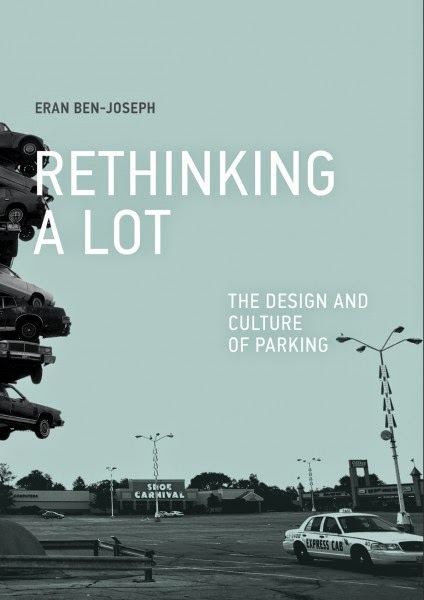
ReThinking a Lot: The Design and Culture of Parking


ReThinking a Lot: The Design and Culture of Parking by Eran Ben-Joseph is a beautiful book from the MIT Press. Fully illustrated and printed on very heavy paper, although it only had 157 pages the book seemed a lot thicker. It was a pleasure to hold and examine ReThinking a Lot, and I learned more than I could ever imagine about parking lot construction, the history of parking lots and about the environmental impact lots have wrought. A casual reader such as myself can be entertained by a book about parking lots, and Ben-Joseph showed how lots can serve drivers as well as those without cars.

Through data gathered from municipal plans, parking revenues and mall layouts, Ben-Joseph asserts that there is a superabundance of parking places in the US. So how come drivers are always complaining about the lack of parking? The answer is that drivers are greedy, and expect a convenient spot everywhere they go. This sense of entitlement makes drivers circle endlessly through lots looking for a better spot. Ben-Joseph cites a study about this circling phenomenon, which concludes that drivers who park further away from their destination (like the mall doors) take less time getting there than drivers who keep trying to find a spot that is closer. In the long run, the extra driving doesn't pay off.

Ben-Joseph continues:

"Something similar to this 'split personality' is at play in our attitudes toward parking lots; we demand convenient parking everywhere we go, and then learn not to see the vast, unsightly spaces that result. For many, parking lots are a necessary evil--we hate them, but we can't do without them."

It is this reference to lots as "unsightly spaces" that interests the author the most:

"Parking lots may be utilitarian and practical, unexceptional, and even unpleasant, but their magnitude and sheer frequency of occurrence merit greater attention. The task is first to rediscover their virtues and common good, and second to elevate their design beyond mediocrity. Even when dealing with the generic, there should be ambition and a desire for perfection."

Nothing is more unsightly than a blacktop lot radiating heat. What can be done to make lots more attractive? Ben-Joseph examines many lots that integrate the natural environment and which are friendly towards their surroundings as well. Asphalt is impervious and hinders drainage. It also creates parking lots of soaring heat. Wastewater and rain can be absorbed by using grass or porous paving materials. Sports stadiums, homes to many of the biggest lots which lie empty most of the time, are the biggest offenders. Why not use these porous materials or otherwise landscape the surface to better drain water? Plenty of examples were given--most of them in Europe--where the lots are camouflaged by tree cover and are thus shaded, making it less of an oppressive atmosphere to walk from or back to one's car.

Landscaping in parking lots has benefits other than to the environment. Ben-Joseph states:

"CPTED [crime prevention through environmental design] strategies toward crime prevention and the increased perception of safety have also been applied to parking lot design. While one of the most common parking lot design approaches is to maintain vistas and reduce vegetation (natural surveillance), research also shows that feeling secure in parking lots correlates with attractive landscaping. The research suggests that vegetation may increase perceptions of both attractiveness and security if it is well maintained and attractively landscaped. The presence of unmaintained, weedy vegetation might have the opposite effect on security perceptions, particularly in isolated, rundown areas."

When parking lots are not occupied by cars, they lie open and ready for the taking. Ben-Joseph discussed alternative uses for parking lots, many of which originated as spontaneous drop-in events like flea markets and concerts. A wide open space free for the taking is irresistible for those who are hosting community events which draw mainly pedestrians--hence no need for parking.

"As the examples in this book illustrate, a successful parking lot is one that integrates its site conditions and context, takes measures to mitigate its impacts on the environment, and gives consideration to aesthetics as well as the driver-parker experience. Designed with conscientious intent, parking lots could actually become significant public spaces, contributing as much to their communities as great boulevards, parks, or plazas. For this to happen, we need to release ourselves from the singular, auto-centric outlook for the use of the lot. We need to reevaluate conventional parking requirements against evolving lifestyles and changing priorities. Above all, we need to accept that parking lots are primary settings for many aspects of public life for Americans, and for a growing number of others across the globe. For something that occupies such a vast amount of land, and is used on a daily basis, the parking lot has received scant attention. It's time to ask: what can a parking lot be? It's time to rethink the lot."

The MIT Press made ReThinking a Lot attractive to the look and touch. Its typeface was unfortunately too small for me, and I read the book at home with a magnifying glass. I found steadying a magnifying glass while trying to read on the bus not easy. The lengthy captions under the photos were repeated word for word in the adjacent text, so there was a lot of redundancy when a shorter caption would have sufficed.

Thursday, May 7, 2015

Without You, There Is No Us: My Time with the Sons of North Korea's Elite: A Memoir


Suki Kim taught English to the sons of North Korea's elite at the Pyongyang University of Science and Technology in 2011. Her perception of life in Pyongyang was the most accurate account I have ever read. I can make this remark because I myself have been there, and as it so happens we were there at the same time. Other writers, journalists even, have padded their own DPRK tales with sensationalism, and Kim wrote about them (without naming names). I always read the same stories about the impoverished brainwashed people of North Korea, yet not here. Kim based Without You, There Is No Us: My Time with the Sons of North Korea's Elite: A Memoir on her own diary and wrote in it every day. Her account reads like a diary's progression of events yet one that is not skewed by hindsight. It could very well have been about my own travel experiences and I recalled many events from Kim's time there that occurred in exactly the same way. Whether one is an employee of a private university or a tourist, everyone must endure the same propaganda-filled travel experience. Even her attempts to send E-mails home was the same as mine. Knowing that our mails were monitored, we worried about immediate deportation should the authorities perceive anything that we wrote as critical of their country. 

Kim taught English at two levels, one the most advanced class and the other the least advanced. In her interactions she was first subjected to canned responses from her students spouting the party line, yet only towards the end of her teaching assignment was she able to break down the barrier between them, although ever so slightly, when some of her students started to express what could be considered an independent opinion.

When she first met her students, however, they seemed more like robots than nineteen- or twenty-year-old men:

"They were eager, polite, and hard working. 'Teacher's paradise' (as some teachers called it) was not an exaggeration. No American students were ever this obedient. As a group, they rose in unison the minute I entered the classroom, not sitting down until I told them to do so. They shouted out each answer together, hung on my every word, and demanded more homework. I almost felt like a military sergeant rather than an English teacher. I had never been revered so absolutely."

Eager to impress their American teacher, they puffed out their chests with nationalist bravado:

"They emphatically insisted that Juche Tower was the tallest in the world; that their Arch of Triumph was the highest, certainly higher that the one in Paris (true); that their amusement park was the best in the world. They were always comparing themselves to the outside world, which none of them had ever seen, declaring themselves the best. This insistence on 'best' seemed strangely childlike, and the words best and greatest were used so frequently that they gradually lost their meaning."

One observation that Kim made with astonishment was the lack of resources within the top-ranking university. How can the sons of the country's elite (who are party members or otherwise well-to-do men--not women--of influence) be expected to lead the future when there was no Internet access? How can they exceed when no one has any concept of critical thinking or comparative analysis? Kim's essay assignments were exercises in futility. None of her students knew how to present a theory, introduce it and back it up. In North Korea, one accepts everything one reads without question. There is no need to question anything, so the concept of proving a thesis is foreign to them.

The Pyongyang University of Science and Technology was in an enclosed compound where not only the teachers but the students themselves were sequestered. Students were separated from their families, even if they lived in Pyongyang. Kim learned to adapt to her environment, but hated it. It gave her an understanding of what life was like for her students as well as the North Korean population in general:

"We accepted our situation meekly. How quickly we became prisoners, how quickly we gave up our freedom, how quickly we tolerated the loss of that freedom, like a child being abused, in silence. In this world, there were no individual demands, and asking permission for everything was infantilizing. So we began to understand our students, who had never been able to do anything on their own. The notion of following your heart's desire, of going wherever you chose, did not exist here, and I did not see any way to let them know what it felt like, especially since, after so little time in their system, I had lost my own sense of freedom."

Kim had to have every lesson she prepared approved by a mysterious group of Big Brother figures known as the "counterparts". At least she had the freedom to design her own curriculum, and only rarely were her lesson topics vetoed. Just as when I visited the DPRK, I was given an instruction package (yes--a package) and had to attend a ninety-minute briefing on what to do and what definitely not to do while over there. Kim had to watch her tongue because each class had anonymous monitors and secretaries in attendance, who would inform the counterparts what she was teaching them if she strayed off course, so she couldn't slip in anything that had heretofore been vetoed. Thus she was left at first with a degree of chilled suppression of her own voice:

"Yet it was understandable that we would sometimes forget to be careful, since we had not been raised in an atmosphere of hypervigilance. With each day, I found myself slipping, usually at meals, where our conversations were more informal. Sometimes after teaching all morning, I became clumsy from fatigue. Other times I slipped on purpose."

Since Kim taught at a university specializing in science and technology, she was wary of the uses her instruction would impart:

"Some days I had the uneasy feeling that I might be teaching the very people who were monitoring our emails, that I was training them so that they could spy better."

By the end of her first semester, Kim felt powerless. As a teacher, she ought to open the world to her students. She should be able to tell them about foreign cities, movies and technology. While the students did look curiously at her electronic gadgetry, they did so while holding back, as if they were afraid to show too much of an interest. Conflicted about whether or not she intended to return the following semester, Kim had to be careful lest she jeopardize her future at the university. Thus on the final day of her first class:

"I could not say, as I shook hands with each of them, Leave this wretched place. Leave your wretched Great Leader. Leave it, or shake it all up. Please do something."

The most apt remark was one that I liken to a belligerent toddler who is hungry yet still throws his bowl to the floor:

"They say that they want to learn English, but they don't like us. Their attitude is like 'Just give us the English we need but don't stop over this way.' But you can't expect everything when you give nothing."

So just have the teachers come over to teach the elite English, but don't expect to do anything else. You will have no freedoms, you will not be able to do anything you want, and you will play by our rules while you teach us only what we approve. And we will expect you to like it that way. That attitude cannot survive for long. No one will endure those conditions without getting something in return--like a walk outside the university compound, for starters. Kim concludes with the observation that engagement with the outside world--the English-speaking capitalist economies in particular--is necessary for the survival of the North Korean people:

"That was the inherent contradiction. This was a nation backed into a corner. They did not want to open up, and yet they had no choice but to move toward engagement if they wanted to survive. They had built the entire foundation of their country on isolationism and wanting to kill Americans and South Koreans, yet they needed to learn English and feed their children with foreign money."

Kim left the DPRK shortly after the death of the Dear Leader Comrade General Kim Jong Il. Her students' tearful goodbyes and pleas to stay were wiped clean--as if they had never happened--once news broke of the death of their beloved Dear Leader. Kim, the venerated teacher who was leaving the university, was now totally blanked. Ignored. Her students could not even register her presence as they all mourned the sudden loss of Kim Jong Il. When she finally managed to get some of them to express a personal opinion, the Dear Leader died. All her work towards developing their independent minds was in vain as each citizen would have to embark on a lengthy period of official mourning. No one strayed from this routine for fear of punishment. The regime had a lock on individual expression and under Kim Jong Un, still does.

Sunday, May 3, 2015

Salt Sugar Fat: How the Food Giants Hooked Us


Salt Sugar Fat: How the Food Giants Hooked Us by Michael Moss is an excellent addition to a bookshelf that includes works by Michael Pollan, Eric Schlosser, Marian Nestle and others who write about the health of our food and the un-health of the industrial food system. Moss lifts the curtain on the giant corporations that engineer and market convenience foods and processed foods. What he reveals is largely invisible to us on a daily basis, yet affects our society significantly - and catastrophically.

Moss is a seasoned investigative reporter - he was the first to expose trans fats, and more recently "pink slime" - and this book is a tour de force of research. Moss takes you to the laboratory and the board room, where chemical engineers and marketing executives contrive to get North Americans eating more and more of everything unhealthy. (The book is written in a US context, but it is equally relevant to Canada.)

Salt Sugar Fat is full of wonderful mini-histories of corporations like Kellogg's and Kraft, and eye-popping demographic data about what North Americans eat. You'll learn how our food has become increasingly sweeter, increasing both our tolerance and desire for ever-sweeter food. How we eat three times as much cheese as we did 40 years ago, now that cheese - or more accurately, a processed substance distantly related to real cheese - is used as an additive in countless foods. And especially, the myriad ways that the holy trinity of salt-sugar-fat is used by food engineers to encourage overconsumption.

Here's an example of a little gem I gleaned from this book. I've always scoffed at fruit drinks that are cynically marketed as containing "10% real juice," meaning, of course, that they are 90% water and sugar. For people accustomed to drinking soda (pop), 10% real juice may seem like a healthy improvement. But Moss describes the how the "juice" in those drinks is created.
At is extreme, the process results in what is known within the industry as "stripped juice," which is basically pure sugar, almost entirely devoid of the fiber, flavors, aromas, and any of the other attributes we associate with real fruit. In other words, the concentrate is reduced to just another form of sugar, with no nutritional benefit over table sugar or high-fructose corn syrup. Rather, its value lies in the healthy image of the fruit that it retains. ... A company like General Foods can use this stuff and still put the comforting words contains real fruit on the box.
Much of Salt Sugar Fat is about economics. Moss quotes a parade of food executives - whistleblowers and industry faithfuls alike - who are all caught in the same trap: reduce the amount of salt, sugar, or fat, and the product's taste will suffer drastically. Therefore consumers will buy less. Therefore consumers will buy the competitor product without the reduced additives. And therefore the company cannot reduce the additives.

When reductions are possible, they are immediately offset. It is a principle of the processed food industry - the first commandment, the sacrosanct law - that a reduction in one of the trinity must be countered with an increase in another. Is the product lower fat? Then it is higher in salt. Is it slightly lower in salt? Then it is higher in sugar. Without copious amounts of these three ingredients in various engineered forms, processed food would be completely inedible.

One such tale from within Kraft Foods said it all. A group of high-level insiders was very concerned about the health implications of the company's products. There was no getting around it anymore: these processed foods are contributing to skyrocketing rates of hypertension, heart disease, and diabetes. (Moss refers to this as "the obesity epidemic," but it is actually about health, not weight.) These Kraft insiders fought against a deeply entrenched corporate culture, risking their livelihoods, to force their colleagues to face these facts. They worked very hard, and succeeded in reducing some of the salt-sugar-fat in the company's products by a tiny bit. Only a tiny bit, one might say, but a start.

Then the sales figures came in. These concerned insiders were immediately slapped down by the board of directors, speaking for the shareholders. Wall Street reminded the company that they are not in the business of caring about what consumers eat. They are in the business of making money. The executive behind the internal movement was demoted, her career significantly curtailed.

Are companies trying to do better? Moss crunches the numbers.
"In Capri Sun alone we took out 120 billion calories," [Kraft executive] Firestone said. ... "We've looked at the amount of sodium we've taken out. Last year was six million pounds, and we're going to add nine billion servings of whole grain between now and 2013..."

If those numbers sound impressive consider what Michelle Obama manged to wrestle out of the entire processed food industry in 2010, after asking for their help in fighting obesity. "I am thrilled to say that they have pledged to cut a total of one trillion calories from the food they sell annually by the year year 2012, and 1.5 trillion calories by 2015," she announced. ...

The math on all this, however, is less compelling. If everyone in America consumed the standard 2,000 calories a day, or 730,000 a year, the 1.5 trillion in saved calories would reduce our collective eating by not quite 1 percent. Its actually bleaker than that, according to some health policy experts. In reality, many of us consume far more than 2,000 calories, and processed foods make up a large part, but not all, or our diets. So the real drop in consumption from those 1.5 trillion calories is likely much less than that 1 percent. Still, it's a start.
Is it? Salt Sugar Fat leads one to question a system that would rely on these industries to safeguard consumer health. And what about the government agencies tasked with keeping the industries in check? They are a significant part of the problem.
With the American people facing an epidemic of obesity and hardened arteries, the "People's Department" doesn't regulate fat as much as it grants the industry's every wish. Indeed, when it comes to the greatest sources of fat - meat and cheese - the Department of Agriculture has joined industry as a full partner in the most urgent mission of all: cajoling the people to eat more.
Moss frequently notes the connections between the processed food industry and the tobacco industry. Kraft and General Foods - the two mega-giants of processed food - were for a long time owned by the Philip Morris corporation. Kraft and General Foods, now one company, are no longer owned by Big Tobacco, but the marketing and engineering principles of that industry informed the companies' cultures and decision-making. The language of addiction and the view of salt-sugar-fat as narcotics run through this book.

When reading Salt Sugar Fat, it's difficult to avoid the conclusion that this is, at bottom, an economic problem. Moss touches on these issues; for example, he mentions more than once the class divide between the food industry executives, who never eat their own products, and their customers. But I wish he went further. For example, Moss writes about the convenience stores overloaded with processed foods, selling no fresh foods at all, and the insidious (and invisible) industry practices that cause this. But he mentions only once, in passing, that these same neighbourhoods are usually food deserts, making processed food laden with salt-sugar-fat the only option for many low-income families.

Another economic factor Moss alludes to, but doesn't examine, is something we hear about all the time in a non-economic context: families are so busy now, both parents work (usually portrayed as "more women are in the workforce"), families don't have time to cook proper meals. That's worth examining, too. Why are families so much busier now, why do both parents work? One principal reason: for most people, it's impossible to raise a family on one income, because the cost of living, especially housing costs, has far outstripped wages.

For anyone writing about the food industry and overconsumption, economic factors are an intrinsic part of the picture. Moss understands that. I just wish he went further.

It's not only an economic issue, of course. It's also an education issue. In my workplace yesterday, a colleague left some "healthy" cereal out to share. Its packaging was full of claims like "no preservatives" and "all natural". Everything about it, down to the colours and fonts used on the packaging said "healthy" and "alternative". The first four ingredients, in order, were: sugar, wheat, corn syrup, and honey. That is, three of the four top ingredients are sugar. And the wheat is not even whole grain, so the human body processes it largely as sugar.

In the end, Moss concludes that we have a choice. We control what we buy. We control what we eat. We can choose to not eat processed food and convenience food.

That is technically true. But it is also incomplete, reductionist, and disingenuous, as Moss himself has shown in more than 400 pages of excellent writing and impeccable research. The individual consumer must be extremely motivated, and blessed with a mighty will, to withstand the economic, social, cultural, and biological forces stacked up against her. The stuff is engineered to make us over-consume, our bodies are biologically programmed to like the stuff and want more ofi t, and many of us cannot afford to do otherwise.

Despite these critiques, Salt Sugar Fat: How the Food Giants Hooked Us is page-turning, eye-opening, thought-provoking book that I highly recommend. (This review was originally published on wmtc.)

Wednesday, April 29, 2015

Iron Kingdom: The Rise and Downfall of Prussia, 1600-1947


400 years, more or less. That is how long Prussia existed as an independent political unit. Christopher Clark’s Iron Kingdom: the rise and downfall of Prussia, 1600-1947 explores the history, so full of incident and drama, of this north German state.

So what is Prussia?  The dates featured in the title are somewhat arbitrary. The Duchy of Prussia existed since 1525 morphing in the proceeding centuries into a modern state that was essentially shattered after World War I though it took until 1947 (post World War II) for the official abolition. I mentioned it is located in northern Germany but to be specific it was the lands in and around Berlin (historically called the March of Brandenburg—a Roman thing) which united with the Duchy of Prussia. Why did Brandenburg and the Duchy of Prussia unite? For an explanation I need to introduce another name, the House of Hohenzollern. The Hohenzollern was a royal dynasty first mentioned in the record books in 1061. The Hohenzollerns eventually went on to become the hereditary kings of Prussia and later Emperors of the united German lands (with Austria as a notable exception).   Prussia didn’t have much going for it in the early days. Impoverished of natural resources and with lots of sandy soil in and around Berlin making farming a challenge, Prussia had the deck stacked against it. To add to its national anxiety Prussia also had lots of potentially dangerous neighbours like Pomerania (another interesting and little known, once upon a time, country that hugged the Baltic Sea), an aggressive and sometimes expansionist Sweden, a haughty France and Austria both of whom looked upon the checkerboard patch of German lands as their military playground and the always massive Russia to the east.

Part of what makes any country, and Prussia is no exception, fascinating are the individuals who lead it and the funny quirks of history that shaped it. Prussia’s history is rich in both famous people and in the auspicious, almost fated, twists and turns in its national narrative. I will mention just two events—perhaps national ideas would be a better term—that shaped the north centre of Europe: the idea of union and the idea of a powerful military.

The idea of a united Germany was in the air since at least the Napoleonic age. The major stumbling block was the question of who would lead the union. Bavaria, Saxony and others mistrusted Prussia. A lot of Prussia’s history can be told with an eye on this idea of influencing and ultimately binding all the various small German states under its guiding hand.

Prussia’s keen desire to create a sophisticated and modern military was a result of its location on the map of Europe. It is this martial tradition that has bequeathed to the world the stereotypical idea of the Prussians as a warrior society, something like a modern day Sparta. The enthusiasm for the art of war would be its downfall. At least this is the common narrative. What I enjoyed about Clark’s Iron Kingdom is that it goes some ways in correcting this overly simplistic chronicle. Prussia was not the whole of Germany, though it was one of its principle voices. Perhaps one of its great gifts to Germany was its military prowess, but it would be a mistake to think that this tradition necessarily lead to Germany’s subsequent involvement as a major protagonist in the two world wars. As Otto Von Bismarck (one of Prussia’s great statesmen) argued, diplomacy and the ability to formulate alliances so as not to go to war is the best policy;  that is, keep the peace by keeping a healthy balance of aligned states that can check each other’s aggrandizing desires. When he died his shrewd advice seemed to die with him. The terrible events that followed only proved to underscore his very sage advice.

Why read the Iron Kingdom? It is first and foremost a dramatic story. Here you have the birth, life and death of an entire country in 688 pages. There are big names in this story that someone who prides him or herself on knowing a thing or two about world history should recognize, names such as Frederick William ‘the Great Elector,’ Frederick II ‘the Great’ and Otto Von Bismarck to name a few of the more notable figures. In many ways countries, nations, states are like people full of hopes and dreams, they strive to face challenges, succeed sometimes and fail at other times and because they are big their impact can be big. Prussia had an immense impact on the history of Europe (and the world) completely out of measure given its smallish size and humble beginnings. Its legacy like a colossal black eagle—an icon featured prominently on all of its flags—looms large across the heart of that continent. To this day whenever there is a reorganization of the electoral boundaries in north eastern Germany, or when a new building or street needs an appellation Germans debate whether to resurrect the term Prussia. The debates are heated. This book goes a ways towards explaining why there is still so much oomph behind that name.

Friday, April 24, 2015

Lifted: A Cultural History of the Elevator


I'd never have thought that I would find a book about elevators so interesting. Lifted: A Cultural History of the Elevator by Andreas Bernard, translated by David Dollenmayer, made the technical aspects of elevators as well as their cultural importance a page-turner. I must commend the translator Dollenmayer, as the text flowed as naturally as if the original text was English. It was a beautiful read. The key to the book's success was its specific reference to the cultural history of elevators. For sure, Bernard talked about how elevators worked and the evolution of lift mechanics. But the focus was the impact of the elevator in culture, especially urban culture, from city planning, the reconstitution of building floor plans, to elevator references in literature and popular culture. Bernard asks early on:

"What effect did the technical apparatus have on the conceivability and expressability of what happens inside the buildings, about the distribution of spaces and people?"

From the late nineteenth century on, the elevator had a profound effect on building construction. Suddenly a central shaft was designed as the centerpiece of all new buildings, and the interiors radiated from this vertical passageway:

"The stairway as means of access to the various levels had to now compete with a vertical shaft cutting a breach through the center of the building: this in turn had far-reaching consequences for the floor plans of new buildings since, as Robinson insisted, the linearity of the transport channel was to be applied to the entire organization of interior space. In office buildings equipped with elevators, the old winding corridors and labyrinthine stairwells replete with blind corners and dead-ends were replaced by a clear distribution of space comprehensible at a glance."

Flowing Scarlett O'Hara staircases, the eye-catching feature in stunning foyers designed to impress the visitor were now architecturally superfluous, primitive even. Suddenly, their central focus as one entered a building disappeared:

"How strongly floor plan configuration was focused on the elevator's conduit from the 1870s on was particularly apparent in the changing status of the stairwell in American buildings. In the course of only one or two decades, this traditional means of vertical access was pushed into the background, downgraded from a grandiose structural element occupying the center of a floor to a mere escape route."

The elevator was regarded with fear at first, at least in the United States. The first elevators were nothing more than platforms enclosed by ornate metallic meshwork. They likely instilled fear in those who stepped into them and slid the doors shut. In the beginning elevators had an on-board operator, whom passengers got to know and trust. With the introduction of push buttons (and the unfortunate en masse unemployment of all elevator operators) passengers were afraid to use the first buttons. But after the period of timid toes and fingers had passed, people learned to like the elevator, and it grew to have a sense of exclusivity. Companies which occupied single buildings relocated their head offices to the top floor (instead of the second floor in the age before elevators). Company executives worked among the clouds, and soon after this, people wanted to live there too. Needing to use an elevator developed into a matter of personal importance, and the higher you lived, the more you needed an elevator to get there. Thus after only a couple decades the top floors of apartments--which were, before elevators, limited to only six storeys with only stairs as the means to ascend to the top--went through a transformation in the organization of living space. No longer were the top storeys reserved for the servants. With so many stairs to climb, the wealthy let the hired help climb them. Now with the elevator, building height could reach skyward, and the rich wanted to be as far away as possible from the ground. Thus was born the exclusive penthouse suite.

The Dakota apartments in New York, perhaps best known as the residence of John Lennon and Yoko Ono, took the elevator to an extra degree of exclusivity. In any other apartment building up until the Dakota was built, the rich had to ride in the same elevators with everybody else. The claustrophobic space of an elevator car kept the passengers standing closely together, too closely together for some. The Dakota offered a solution for its exclusive clientele:

"The Dakota initiated the history of the private elevator, the installation of a vertical passage that made movement in a multistory residential building completely independent of public spaces. This transportation option was so essential to the development of the image of New York because it prepared the way for the final phase of the transformation of Manhattan in the first two decades of the twentieth century: the willingness of the most wealthy class to sell their remaining mansions on Fifth Avenue, together with their building lots, and move into the apartment houses rising in the same location."

Thus many rich families, notably the Vanderbilts and Huttons, were persuaded to sell their downtown mansions provided their new apartments in the luxury buildings going up on their former properties gave them exclusive use of an elevator.

The most interesting part of Lifted was the section on elevators in books and film. In the chapter section entitled "The Moment of Truth: The Stalled Cab as Secular Confessional", I realized that what Bernard wrote was so true:

"In novels, films, and commercials, elevators get stuck with a frequency that bears no relation to official statistics. As Nabokov's Mary and Fechter's Der Ruck im Fahrstuhlshow, elevators tend to appear in big-city stories precisely, and only, at the moment they stop working. Although malfunctions have been infrequent exceptions since the development of safety mechanisms in the early twentieth century, they seem to be the rule in fictional narratives. The reason for this statistically indefensible preference is undoubtedly that, while one can (with difficulty) ignore uncomfortable physical proximity for the length of a normal ride, it becomes oppressively unavoidable in the case of a malfunction."

Isn't it? He elaborates:

"The 'unease' that Lethen says arises 'when the traffic flow is suddenly interrupted or backed up for a long time' is intensified in the elevator, where fiction and film can portray it more sharply than in any other means of transportation. The crises that unfold in the cab are one sign among many that the elevator is a paradigmatic site of modernity."

I can recall many TV episodes I have seen--even commercials--which have taken place in elevators. At the sign of a crisis--like a stuck elevator--the passengers who wouldn't dare glance your way five minutes ago are now confessing their innermost secrets. A stuck elevator is eerily threatening. To be stuck in a box without an escape route can lead to a panic, or a feeling of impending doom:

"If we seek to understand why the elevator is still such a popular location in novels, films, TV series, and advertisements with urban settings, we need to keep in mind the latent threat embodied in this unobservable intersection of individual lives."

Bernard wrote about many feature films with chilling elevator scenes, including a German film which takes place entirely within the claustrophobic confines of the metal box, "Abwärts". I am going to order a copy on-line.

Saturday, April 18, 2015

If Nuns Ruled the World: Ten Sisters on a Mission


Jo Piazza’s If Nuns Ruled the World: Ten Sisters on a Mission is a profile of ten American Nuns, (though as Piazza states in her introduction, they are technically Sisters), who are changing the world through charity, activism and political protest.  At the same time these women are challenging the restrictive and generally negative stereotype of what it means to be a Catholic Sister.  The Sisters that Piazza profiles in this book are not disapproving schoolmarms or uptight nurses, they are working to abolish slavery, have gays and lesbians recognised in the Church, to eliminate nuclear weapons and many other causes.  Despite the good these Sisters are doing they are, in the eyes of the Catholic Church, radical feminists who are challenging key doctrines. According to the Sisters they are working in the spirit of the bible in order to make the world a better place for people on the margins of society, these viewpoints lead to clashes between the established male church hierarchy and the Sisters about what it means to be a good Catholic. What started out as a Master’s thesis on how nuns use social media by Piazza, transformed into a book profiling the lives of ten inspiring and forward thinking women who use their religion to make the world a better place.


The book itself is divided into ten chapters, each profiling and interviewing a different Sister.  These interviews detail the Sister’s specific cause or concern, their history and how they came to join the ministry. Many of the chapters also contain information on how Piazza came to meet them and on their interactions over the course of the interviews. Some are conventional interviews over tea; others are less expected, like a six hour road trip with a Sister who may be incarcerated for political protest, or a movie screening of Eden with a Sister who runs a home from women escaping slavery in New York. Piazza’s history as an entertainment reporter can be seen in her interview style, Piazza says in her introduction that “I want to tell the stories of these nuns as if they were rock stars or Hollywood royalty.”  To a large extent she succeeds, the profiles feel very natural and flow well and like stories of rock stars of Hollywood royalty I longed to know more about each of the Sisters. Every section seemed too brief, even if the book had been twice as long I probably would have wanted to know more about them.  One interesting criticism I read about the book in another review is that Piazza usually describes what each of the Sister’s looks like and what she is wearing. The reviewer found this to be distracting and negative; I however enjoyed this as it further removes Sisters and Nuns from their habits which have not been required uniform since the 1960’s.


Potential readers may be turned off of the book by the religious subject matter, afraid the book is full of Catholic doctrine or written in such a way as to convert people to Catholicism. As a (very) lapsed Roman Catholic I had many of the same reservations. While the book does talk about the spiritual lives of these women and their faith and relationship to the Christian God it does not make any pitches to convert readers or to tout Christianity as any kind of ‘true religion.’ When Piazza, also a non-religious though raised Catholic, does mention faith she is mainly interested in what drew these women into life in a religious order, a life she notes is devoid of “many of the things Americans think of as the trappings of a good and “normal” life: marriage, kids, a sex life.” She is interested in how they use faith to drive their actions. With so many negative portrayals of faith in the world, especially of the Roman Catholic Church it is relieving to a positive example of religion inspiring people to help others.


While the profiles on the Sisters are all fascinating, the reactions from other Catholics as well as the Church Hierarchy are also interesting, though not in the same uplifting and positive sense. Sister Simone Campbell who toured America in 2012 to protest the Republican “Path to Prosperity” budget with the ‘Nun’s on a Bus’ was called a feminazi by Rush Limbaugh and was protested by people calling her a ‘fake nun.’ Others like Sister Jeannie Gramick, who is fighting for a more LGBT friendly church has been threatened with excommunication from the Church itself.  Piazza notes that it is interesting and troublesome that a Church that has been so plagued with scandal in recent years has had a fixation with correcting the behaviour of Nuns, even going so far as to launch a formal investigation into the behaviour of American Nuns in 2008 without any prior allegations of wrongdoing. The male hierarchy of the Roman Catholic Church does not come across as particularly accepting in this book and stands in stark contrast to the more progressive nuns. This is not particularly surprising, though it is upsetting to hear a Sister who tried to speak with a Bishop about allowing women to be ordained was literally laughed at. This section hit me particularly hard since my much more devout eight year old self wanted to be a Catholic Priest and received a similar condescending reaction from a Deacon.


I hadn't intended to read or even review this book, but the title jumped out to me while going through new books and I am glad I picked it up. Positive stories about faith are not front and center in the modern world, neither are stories about people doing good deeds. This book covers both of these as well as profiling ten amazing women that are helping to change what the Catholic Church means in a modern context and helping people who need it the most. To paraphrase Piazza in her introduction she says that she may not believe in God, but she does believe in nuns. After reading about these incredible women, I feel much the same way.